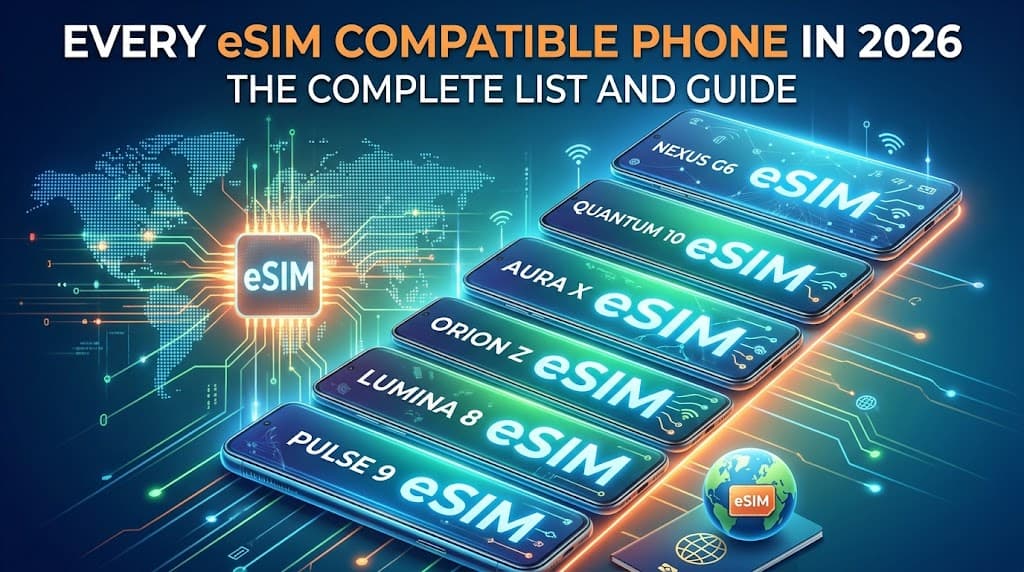
Every eSIM Compatible Phone in 2026: The Complete List and Guide
Discover all eSIM compatible phones in 2026, from the latest iPhone 18 to Galaxy S26. Learn how to check compatibility, use dual SIM, and find the best plans.
The eSIM Revolution in 2026: Your Ultimate Guide to Compatible Phones
Welcome to 2026! The world of mobile connectivity has evolved dramatically, and at the forefront of this transformation is the eSIM. Gone are the days of fumbling with tiny physical SIM cards, especially for global travelers or those juggling multiple numbers. Today, eSIM technology is not just a niche feature; it's the standard, offering unparalleled flexibility and convenience for millions worldwide.
At FindMyEsim.io, we've been tracking this evolution meticulously, comparing 154+ providers across 203+ countries with 13225+ plans to ensure you always find the perfect connection. If you're wondering what an eSIM is and why it's such a game-changer, dive into our comprehensive guide: What is an eSIM? The Complete Guide for 2026.
This guide is your definitive resource for understanding which phones support eSIM technology in 2026. Whether you're an iPhone loyalist, a Samsung enthusiast, a Google Pixel fan, or exploring other brands, we've got you covered. We'll show you how to check your device's compatibility, explore the power of dual SIM with eSIM, and even peek into what the future holds for upcoming devices.
Why eSIM Matters More Than Ever in 2026
In 2026, the benefits of eSIM are more pronounced than ever. For the frequent traveler, switching networks globally is as simple as downloading a new plan – no more hunting for local SIM cards or paying exorbitant roaming fees. For business professionals, it means seamlessly managing work and personal lines on a single device. For everyone, it offers enhanced security (no physical card to lose or steal) and the freedom to instantly activate new services.
The industry has embraced eSIM with open arms. Major manufacturers are integrating it into nearly all their flagship and mid-range devices, and in some markets, certain models are even going eSIM-only. This widespread adoption means that if you're buying a new phone in 2026, there's a very high chance it supports eSIM.
How to Check if Your Phone Supports eSIM (Actionable Advice)
Before diving into our extensive list, it's crucial to confirm if your current device is eSIM compatible. While most modern phones in 2026 support it, there can still be regional variations or older models in circulation. Here’s how you can quickly check:
1. Check Your Phone's Settings
- For iPhones (iOS 17+):
- Go to Settings.
- Tap on Cellular (or Mobile Data).
- Look for an option like Add eSIM, Add Data Plan, or Set Up Cellular. If you see it, your iPhone is eSIM compatible.
- For Android Phones (Android 14+):
- Go to Settings.
- Tap on Network & internet (or Connections on Samsung).
- Tap on SIMs (or Mobile Network).
- Look for an option like Add eSIM, Download a SIM, or Add mobile plan. If available, your Android device supports eSIM.
2. Dial a Special Code
This method works for many Android phones and some iPhones, though it's less common for Apple devices to display EID this way:
- Open your phone's Dialer app.
- Dial
*#06#. - A screen will pop up displaying various numbers, including your IMEI (International Mobile Equipment Identity). Look for an EID (Embedded Identity Document) number. If you see an EID, your phone is eSIM compatible. If you only see IMEI, it likely isn't.
3. Consult Your Phone's Specifications Online
If you're still unsure, the most reliable method is to look up your specific phone model's specifications online. A quick search for "[Your Phone Model] eSIM compatibility" will usually yield definitive results. You can also check your phone's original packaging or manual, which often lists supported SIM types.
Important Note on Regional Variations: While a phone model might generally support eSIM, some regional variants (e.g., specific models sold in China, Hong Kong, or Macau) might only have physical dual SIM slots and no eSIM support. Always double-check your specific device's model number and region of origin.
eSIM Compatible iPhones (2026 Update)
Apple has been a major driving force behind eSIM adoption, starting with the iPhone XS series. By 2026, nearly all iPhones released in the last few years are eSIM compatible, with newer models in certain regions going eSIM-only.
Apple iPhone 18 Series (Released Late 2025/Early 2026)
The latest and greatest from Apple. All iPhone 18 models (iPhone 18, iPhone 18 Plus, iPhone 18 Pro, iPhone 18 Pro Max) sold in the US, Canada, and many European and Asian markets are eSIM-only, supporting multiple active eSIMs. International variants typically offer one physical SIM + multiple eSIMs.
Apple iPhone 17 Series (Released Late 2024)
Following the trend, the iPhone 17, 17 Plus, 17 Pro, and 17 Pro Max are also eSIM-only in North America and many other regions. Elsewhere, they support one physical SIM + multiple eSIMs.
Apple iPhone 16 Series (Released Late 2023)
Similar to the 17 and 18 series, the iPhone 16, 16 Plus, 16 Pro, and 16 Pro Max are eSIM-only in the US and Canada, and dual SIM (physical + eSIM) in most other international markets.
Apple iPhone 15 Series (Released Late 2022)
The iPhone 15, 15 Plus, 15 Pro, and 15 Pro Max continue the eSIM-only trend for models sold in the United States. International versions support dual SIM (physical + eSIM).
Apple iPhone 14 Series (Released Late 2022)
A landmark series, the iPhone 14, 14 Plus, 14 Pro, and 14 Pro Max were the first to go eSIM-only in the United States. All other international versions support dual SIM (physical + eSIM).
Apple iPhone 13 Series (Released Late 2021)
All models (iPhone 13 mini, iPhone 13, iPhone 13 Pro, iPhone 13 Pro Max) support dual SIM with one physical SIM and one eSIM.
Apple iPhone 12 Series (Released Late 2020)
All models (iPhone 12 mini, iPhone 12, iPhone 12 Pro, iPhone 12 Pro Max) support dual SIM with one physical SIM and one eSIM.
Apple iPhone 11 Series (Released Late 2019)
All models (iPhone 11, iPhone 11 Pro, iPhone 11 Pro Max) support dual SIM with one physical SIM and one eSIM.
Apple iPhone XS, XS Max, XR (Released Late 2018)
These were Apple's first eSIM-compatible phones, supporting dual SIM with one physical SIM and one eSIM.
iPhone SE (2nd, 3rd, and 4th Gen)
All generations of the iPhone SE (2020, 2022, and the latest 2025 model) support dual SIM with one physical SIM and one eSIM.
Important Exception: iPhones sold in mainland China, Hong Kong, and Macau typically do not support eSIM. Instead, they feature dual physical SIM card slots. Always verify your specific model's region of origin.
eSIM Compatible Samsung Galaxy Phones (2026 Update)
Samsung has also widely adopted eSIM, especially in its flagship Galaxy S and foldable Z series. By 2026, many mid-range A-series phones also offer eSIM functionality.
Samsung Galaxy S26 Series (Released Early 2026)
The latest flagship series (Galaxy S26, S26+, S26 Ultra) fully supports eSIM globally, often alongside a physical SIM slot for dual SIM functionality.
Samsung Galaxy S25 Series (Released Early 2025)
All models (S25, S25+, S25 Ultra) are eSIM compatible, supporting dual SIM (physical + eSIM).
Samsung Galaxy S24 Series (Released Early 2024)
All models (S24, S24+, S24 Ultra) are eSIM compatible, supporting dual SIM (physical + eSIM).
Samsung Galaxy S23 Series (Released Early 2023)
All models (S23, S23+, S23 Ultra) are eSIM compatible, supporting dual SIM (physical + eSIM).
Samsung Galaxy S22 Series (Released Early 2022)
All models (S22, S22+, S22 Ultra) are eSIM compatible, supporting dual SIM (physical + eSIM).
Samsung Galaxy S21 Series (Released Early 2021)
All models (S21, S21+, S21 Ultra) are eSIM compatible, supporting dual SIM (physical + eSIM).
Samsung Galaxy Z Fold & Z Flip Series (All Recent Generations)
From the Galaxy Z Fold3/Flip3 (2021) onwards, all foldable models (Z Fold4/Flip4, Z Fold5/Flip5, Z Fold6/Flip6, Z Fold7/Flip7) fully support eSIM, typically in combination with a physical SIM slot.
Samsung Galaxy A Series (Select Newer Models from 2024/2025 Onwards)
Many newer mid-range A-series phones, such as the Galaxy A56, A57, A75, A76 (and subsequent models from 2025/2026), have integrated eSIM support, especially in certain markets. Always check the specific model's specifications.
Note: Samsung Galaxy S20 series (2020) and Note 20 series (2020) also support eSIM in many regions, though their adoption was less universal than subsequent models. Always verify for older devices.
eSIM Compatible Google Pixel Phones (2026 Update)
Google has been an early and consistent adopter of eSIM technology, making nearly all its Pixel phones from the Pixel 3 onwards eSIM compatible.
Google Pixel 11 Series (Released Late 2025/Early 2026)
The latest Pixel flagships (Pixel 11, Pixel 11 Pro, Pixel 11 Pro Max, Pixel 11a) fully support eSIM alongside a physical SIM (or dual eSIM capability in some markets).
Google Pixel 10 Series (Released Late 2024)
All models (Pixel 10, Pixel 10 Pro, Pixel 10a) are eSIM compatible, supporting dual SIM (physical + eSIM).
Google Pixel 9 Series (Released Late 2023)
All models (Pixel 9, Pixel 9 Pro, Pixel 9a) are eSIM compatible, supporting dual SIM (physical + eSIM).
Google Pixel 8 Series (Released Late 2022)
All models (Pixel 8, Pixel 8 Pro, Pixel 8a) are eSIM compatible, supporting dual SIM (physical + eSIM).
Google Pixel 7 Series (Released Late 2021)
All models (Pixel 7, Pixel 7 Pro, Pixel 7a) are eSIM compatible, supporting dual SIM (physical + eSIM).
Google Pixel 6 Series (Released Late 2020)
All models (Pixel 6, Pixel 6 Pro, Pixel 6a) are eSIM compatible, supporting dual SIM (physical + eSIM).
Google Pixel 5, 4, 3a, 3 (Released 2018-2020)
Even older Pixel models like the Pixel 5, Pixel 4a, Pixel 4, Pixel 3a, and Pixel 3 (excluding some specific Japanese variants) are eSIM compatible, offering a physical SIM + eSIM setup.
eSIM Compatible Motorola Phones (2026 Update)
Motorola has primarily focused its eSIM efforts on its premium and foldable devices, with broader adoption in newer models by 2026.
Motorola Razr Series (All Recent Foldable Models)
All modern Motorola Razr foldable phones, including the original Razr (2020), Razr 5G (2020), Razr 2022, Razr 40, Razr 40 Ultra, Razr 50, and Razr 50 Ultra, support eSIM, often in combination with a physical SIM.
Motorola Edge Series (Select Newer Models from 2024/2025 Onwards)
Many of the newer flagship and high-end Motorola Edge series phones from 2024 and 2025, such as the Edge 60, Edge 60 Pro, Edge 70, Edge 70 Pro (and subsequent models), have integrated eSIM support in various regions. Compatibility can vary by specific model and country, so always check.
Other Motorola Models
While less common in their mid-range or budget lines, some newer Motorola G-series phones released in 2025/2026 for specific markets might also begin to feature eSIM. Always consult the device's official specifications.
Other Brands and Devices Supporting eSIM (2026 Update)
The embrace of eSIM extends far beyond the big three. Many other manufacturers have integrated eSIM into their flagship and increasingly, mid-range devices by 2026.
Huawei
Many Huawei flagship models, particularly from the P series and Mate series (e.g., P60, P70, Mate 50, Mate 60, Mate 70, and subsequent models from 2023-2026), offer eSIM support in select international markets. Compatibility can be highly regional due to ongoing geopolitical factors.
Sony Xperia
Sony has gradually adopted eSIM in its premium Xperia lineup. Models like the Xperia 1 VI, Xperia 5 VI, Xperia 1 VII, Xperia 5 VII (and subsequent models from 2024-2026) are generally eSIM compatible, often with dual SIM (physical + eSIM) functionality.
Xiaomi/Redmi/POCO
Xiaomi has significantly expanded its eSIM support in its flagship series. The Xiaomi 14, Xiaomi 15, Xiaomi 16 (and subsequent models from 2024-2026) and some high-end Redmi and POCO devices now feature eSIM, particularly in global variants. Regional availability is a key factor here.
OnePlus
OnePlus, known for its "flagship killer" devices, has increasingly included eSIM. The OnePlus 12, OnePlus 13, OnePlus 14 (and subsequent models from 2024-2026) typically support eSIM, often with dual physical SIM slots as well.
Oppo/Vivo/Realme
These BBK Electronics brands have also joined the eSIM trend, primarily in their flagship and premium mid-range offerings. Look for eSIM support in models like the Oppo Find X7, Find X8, Vivo X100, X110, Realme GT5, GT6 (and subsequent models from 2024-2026), especially in their global versions.
Laptops & Tablets
It's worth noting that eSIM isn't just for phones! Many modern cellular-enabled laptops and tablets also support it, allowing for always-on connectivity without a physical SIM slot. Examples include:
- Microsoft Surface Pro LTE/5G models
- Apple iPad (Cellular models from 7th Gen onwards, including all iPad Air and iPad Pro models)
- Lenovo, HP, Dell laptops with integrated cellular modems
Smartwatches
Many cellular smartwatches rely on eSIM for standalone connectivity, allowing you to make calls, send messages, and stream music without your phone nearby. Popular examples include:
- Apple Watch (Cellular models)
- Samsung Galaxy Watch (LTE models)
- Google Pixel Watch (LTE models)
Summary of eSIM Compatibility by Brand (Quick Reference 2026)
| Brand | Key eSIM Compatible Series (2026) | Notes |
|---|---|---|
| Apple | iPhone 18, 17, 16, 15, 14 (US eSIM-only), 13, 12, 11, XS/XR, SE (2nd-4th Gen) | Most global models support physical SIM + eSIM. US iPhone 14-18 are eSIM-only. China models typically no eSIM. |
| Samsung | Galaxy S26, S25, S24, S23, S22, S21, Z Fold/Flip (all from Gen3+), select A-series (from 2024/2025) | Generally physical SIM + eSIM. Widespread adoption in flagships. |
| Google Pixel | Pixel 11, 10, 9, 8, 7, 6, 5, 4, 3a, 3 | All models from Pixel 3 onwards are eSIM compatible. Physical SIM + eSIM. |
| Motorola | Razr (all modern foldables), select Edge series (from 2024/2025) | Focus on premium and foldable devices. Check specific model for Edge series. |
| Huawei | P70, P60, Mate 70, Mate 60 (select international models) | Regional availability varies significantly. |
| Sony | Xperia 1 VII, 5 VII, 1 VI, 5 VI (and newer) | Premium Xperia models. |
| Xiaomi/OnePlus/Oppo/Vivo/Realme | Flagship models (e.g., Xiaomi 16, OnePlus 14, Oppo Find X8, etc. from 2024/2025 onwards) | Growing adoption in flagships, highly dependent on specific model and region. |
Dual SIM + eSIM Combinations: The Best of Both Worlds
By 2026, the concept of "dual SIM" has largely evolved to mean "physical SIM + eSIM" or even "dual eSIM" (especially on eSIM-only devices like US iPhones). This combination offers incredible flexibility:
- Seamless Travel: Keep your home physical SIM active for calls/texts while using an eSIM from FindMyEsim.io for affordable data when abroad.
- Work-Life Balance: Maintain separate phone numbers for personal and professional use on a single device, without carrying two phones.
- Optimized Coverage: Use different carriers for different areas to ensure you always have the best signal.
- Cost Savings: Leverage the cheapest eSIM plans in 2026 for data while keeping your primary number active.
Most modern eSIM-compatible phones allow you to store multiple eSIM profiles, even if only one or two can be active simultaneously (e.g., one physical SIM + one eSIM, or two active eSIMs). This means you can download several eSIMs for different countries or purposes and switch between them with ease.
The Future is eSIM-Only: What to Expect from Upcoming Devices
The trend is clear: the future of mobile connectivity is eSIM-only. Apple's bold move with the iPhone 14 series in the US has set a precedent, and by 2026, we're seeing more manufacturers and regions follow suit. While global adoption of eSIM-only devices might take a few more years to become universal, it's an inevitable shift.
What does this mean for you?
- Increased Convenience: No more physical cards to manage, lose, or swap.
- Sleeker Devices: Manufacturers can design phones with fewer openings, potentially improving water resistance and freeing up internal space.
- Instant Activation: Get connected almost instantly, anywhere in the world, by simply downloading a profile.
As you consider your next phone purchase, especially in late 2026 and beyond, anticipate that more and more devices, particularly flagship models, will either prioritize eSIM or offer it as the sole connectivity option in key markets. Being familiar with eSIM technology now will put you ahead of the curve.
Finding Your Perfect eSIM Plan with FindMyEsim.io
Now that you know your phone is eSIM compatible, the next step is to find the perfect plan! This is where FindMyEsim.io truly shines. With our extensive database, we make it incredibly easy to compare and choose the best eSIM for your needs.
Whether you're looking for a local plan, international roaming, or just the best value for money, our platform allows you to filter by country, data allowance, validity, and price. We list 154+ providers offering 13225+ plans across 203+ countries, ensuring you always get the most competitive rates and reliable service.
Don't settle for expensive roaming or unreliable connections. Visit FindMyEsim.io to compare and secure your next eSIM. It's the smartest way to stay connected in 2026.
Frequently Asked Questions (FAQ)
Is my phone guaranteed to be eSIM compatible if it's on this list?
While this list is comprehensive for 2026, it's crucial to perform the compatibility check (via settings or *#06#) on your specific device. Regional variations, carrier-locked models, or specific sub-models can sometimes lack eSIM functionality even if the general series supports it. Always double-check your exact model and region of purchase.
Can I use multiple eSIMs on one phone?
Yes, absolutely! Most eSIM-compatible phones can store multiple eSIM profiles (often 5-10 or more), though typically only one or two can be actively used at any given time. For example, you might have your home physical SIM active, and an eSIM for your current travel destination. Or, on eSIM-only phones like US iPhones, you can have two eSIMs active simultaneously. You can easily switch between stored eSIM profiles in your phone's settings.
What's the difference between dual SIM and dual eSIM?
Dual SIM generally refers to a phone that can use two different phone numbers/networks simultaneously. Traditionally, this meant two physical SIM card slots. With eSIM, it often means one physical SIM card slot and one eSIM. Dual eSIM specifically refers to a device that can have two eSIM profiles active at the same time, without needing a physical SIM card at all. This is common in eSIM-only devices like the latest US iPhones.
Will my old phone stop working with a physical SIM?
No, not at all. eSIM compatibility is an added feature. If your phone supports a physical SIM, it will continue to work perfectly with physical SIM cards. The move towards eSIM-only devices is primarily for new phone models being manufactured, not a change that affects existing physical SIM slots in older phones.
How do I install an eSIM once I've purchased it?
Installing an eSIM is straightforward and usually involves scanning a QR code or manually entering details provided by your eSIM provider. For a detailed, step-by-step guide on how to install an eSIM on both iPhone and Android devices, please refer to our dedicated article: How to Install an eSIM on iPhone & Android (Step-by-Step Guide for 2026).
FindMyEsim Editorial
eSIM Experts
The FindMyEsim team compares eSIM plans from 40+ providers to help travelers stay connected. We test, review, and analyze pricing so you can find the best deal for every destination.
Find the perfect eSIM for your next trip
Compare plans from 40+ providers across 170+ countries
Compare eSIM Plans