What is an eSIM? The Complete Guide for 2026
Discover what an eSIM is, how it works, supported devices, benefits for travelers, security, and how to get started with this revolutionary technology.
Welcome to the Future of Connectivity: Understanding eSIMs in 2026
In the rapidly evolving landscape of mobile technology, a quiet revolution has been unfolding – one that promises to fundamentally change how we connect, communicate, and travel. We're talking about the eSIM, or embedded SIM, and by 2026, it's not just a niche feature but a mainstream standard for seamless global connectivity.
Gone are the days of fumbling with tiny plastic cards, searching for local SIM vendors in foreign airports, or worrying about losing your primary SIM. The eSIM ushers in an era of digital convenience, offering unprecedented flexibility and control over your mobile network access. Whether you're a seasoned globetrotter, a digital nomad, or simply someone seeking a more streamlined mobile experience, understanding the eSIM is crucial for navigating the connected world of today and tomorrow.
At FindMyEsim.io, we've helped countless users navigate the complexities of eSIMs, comparing 154+ providers across 203+ countries with 13225+ plans. Our goal with this comprehensive guide is to demystify the eSIM, explaining what it is, how it works, which devices support it, and why it's poised to become the default for mobile connectivity. Let's dive in.
What Exactly is an eSIM? Deconstructing the Technology
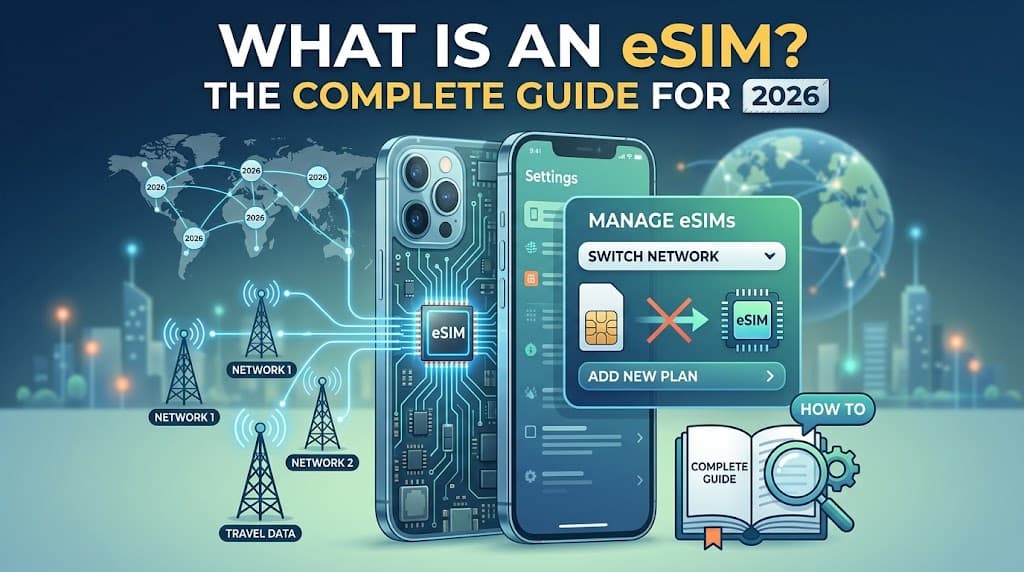
At its core, an eSIM is exactly what its name suggests: an embedded Subscriber Identity Module. Unlike a traditional physical SIM card that you insert into a tray, an eSIM is a small chip permanently built into your device's motherboard. This seemingly minor difference unlocks a world of possibilities.
eSIM vs. Physical SIM: The Fundamental Difference
Think of a physical SIM card as a removable, physical key to your mobile network. It contains your subscriber information, allowing your phone to connect to a specific carrier. If you want to change carriers or use a local network abroad, you physically swap the card.
An eSIM, on the other hand, is like having a digital, reprogrammable key. Instead of swapping physical cards, you download and store your network profile digitally onto the embedded chip. This means you can switch carriers, activate local plans, or manage multiple numbers without ever touching a physical card.
The Technical Underpinnings: How it Works
While the user experience is wonderfully simple, the technology behind eSIMs is sophisticated. Here's a look at the key components:
- eUICC (Embedded Universal Integrated Circuit Card): This is the hardware component – the actual chip soldered inside your device. It's essentially a secure element, similar to the chip on a credit card, designed to securely store multiple network profiles. Unlike a traditional SIM, which comes pre-programmed for a single carrier, the eUICC is designed to be reprogrammed remotely.
- Remote Provisioning: The Magic Behind the Scenes: This is where the true power of eSIM lies. Instead of buying a physical SIM, you purchase an eSIM profile from a carrier or an eSIM provider like those found on FindMyEsim.io. This profile contains all the necessary information (your subscriber ID, authentication keys, etc.) to connect to their network. This profile is then securely downloaded and installed onto your device's eUICC.
- How is it downloaded? The most common method is via a QR code. When you scan a carrier's QR code (usually provided after purchase), your device initiates a secure connection with the carrier's provisioning server. Alternatively, some carriers offer app-based installation or manual entry of activation codes.
- SM-DP+ (Subscription Manager - Data Preparation+): This is a server-side component managed by carriers and eSIM providers. When you scan a QR code or use an app to activate an eSIM, your device communicates with the SM-DP+ server, which securely delivers the encrypted eSIM profile to your device's eUICC. This entire process is standardized by the GSMA (Global System for Mobile Communications Association), ensuring interoperability and security across different devices and networks.
In essence, the eUICC is the blank canvas, and remote provisioning is the digital brush that paints your chosen network profile onto it, making your device instantly ready to connect.
Which Devices Support eSIM? Your 2026 Compatibility Checklist
eSIM technology has rapidly become a standard feature in modern smartphones, tablets, and even smartwatches. By 2026, we're seeing an increasing number of devices, especially flagship models, adopting eSIM-only designs or offering dual eSIM support. It's important to verify your specific model, as compatibility can sometimes vary by region.
Apple iPhones
Apple has been a significant driver of eSIM adoption. Since the iPhone 14 series (released in 2022), all models sold in the United States are eSIM-only, completely ditching the physical SIM tray. We expect this trend to expand to more regions by 2026. Generally, if you have an iPhone from the last few years, you're likely covered:
- iPhone XS, XS Max, XR, and newer: All these models support eSIM, in addition to a physical nano-SIM (except US iPhone 14/15 models).
- iPhone 11, 12, 13, 14, 15 series: All models in these series are eSIM compatible. US models from iPhone 14 onwards are eSIM-only.
Samsung Galaxy Devices
Samsung has also embraced eSIM across its flagship lines, though regional variations are more common than with Apple. Most newer Galaxy devices offer eSIM support alongside a physical SIM slot.
- Galaxy S20, S21, S22, S23, S24 series: Most models (excluding some region-specific variants) support eSIM.
- Galaxy Note 20 series.
- Galaxy Z Fold series (Fold, Z Fold2, Z Fold3, Z Fold4, Z Fold5): All models.
- Galaxy Z Flip series (Z Flip, Z Flip3, Z Flip4, Z Flip5): All models.
Google Pixel Phones
Google was an early adopter of eSIM technology, integrating it into its Pixel line quite rapidly.
- Pixel 3a, 3a XL, and newer: All subsequent Pixel models, including the Pixel 4, 5, 6, 7, and 8 series (and their 'a' and 'Pro' variants), support eSIM.
iPads and Other Tablets
Many cellular-enabled tablets also feature eSIM functionality, making it easy to get connected on the go without Wi-Fi.
- iPad Pro (3rd generation and later).
- iPad Air (3rd generation and later).
- iPad (7th generation and later).
- iPad mini (5th generation and later).
Other Notable Devices (Smartwatches, Laptops)
The reach of eSIM extends beyond phones and tablets:
- Smartwatches: Apple Watch (Series 3 and later, cellular models), Samsung Galaxy Watch (LTE models), Google Pixel Watch (LTE models).
- Laptops: Select Windows laptops with cellular capabilities (e.g., some Microsoft Surface Pro models, Lenovo ThinkPads).
To confirm your device's compatibility, it's always best to check the manufacturer's specifications or your device settings (e.g., on iPhone: Settings > Cellular > Add eSIM; on Android: Settings > Network & internet > SIMs > Add eSIM).
| Device Type | Brand | Models (Examples) | Notes (2026 Outlook) |
|---|---|---|---|
| Smartphones | Apple | iPhone XS, XR, 11, 12, 13, 14, 15 (all variants) | US models iPhone 14/15 are eSIM-only; trend expanding globally. |
| Smartphones | Samsung | Galaxy S20-S24 series, Z Fold/Flip series (all generations) | Widespread adoption, some regional variations in dual SIM vs. eSIM. |
| Smartphones | Pixel 3a, 4, 5, 6, 7, 8 series (all variants) | Strong eSIM support across the entire modern Pixel lineup. | |
| Tablets | Apple | iPad Pro (3rd+ gen), Air (3rd+ gen), Mini (5th+ gen), iPad (7th+ gen) | Cellular models only. |
| Smartwatches | Apple, Samsung, Google | Apple Watch Series 3+, Galaxy Watch LTE, Pixel Watch LTE | Cellular models for standalone connectivity. |
| Laptops | Microsoft, Lenovo, HP | Select Surface Pro, ThinkPad, Spectre models with cellular | Growing integration for always-connected PCs. |
The Unrivaled Benefits of eSIMs Over Physical SIM Cards
The shift from physical to embedded SIMs isn't just a technological gimmick; it offers tangible advantages that significantly enhance the mobile user experience, particularly for travelers.
For the Global Traveler
- Instant Connectivity Abroad: This is perhaps the biggest game-changer. Instead of hunting for local SIM cards upon arrival, you can purchase and activate an eSIM plan before you even board your flight. Landed in Tokyo? Your local data plan is already active. This saves time, reduces stress, and ensures you're connected from the moment you touch down.
- No More SIM Swapping Hassles: Say goodbye to fiddly SIM trays, tiny ejector tools, and the fear of losing your home SIM card. With eSIMs, everything is digital.
- Multiple Profiles, One Device: Most eSIM-compatible devices can store several eSIM profiles simultaneously (e.g., 5-10 or more), though only one or two can be active at a time. This means you can keep your home number active for calls/texts while using a separate eSIM for data when traveling. Imagine having profiles for your home country, a favorite travel destination, and a general global data plan all on one device!
- Cost Savings: eSIMs make it incredibly easy to shop around for the best data deals. Instead of being tied to expensive roaming plans, you can quickly compare and activate local or regional eSIMs from providers on FindMyEsim.io, often at a fraction of the cost.
For Everyday Users
- Dual SIM Functionality (Personal/Work): Even if you don't travel frequently, eSIMs offer immense value. You can use your primary physical SIM (if your phone has a tray) or a primary eSIM for personal use, and a second eSIM for a work number, all on the same device. This eliminates the need for carrying two phones.
- Enhanced Security: A physical SIM card can be physically removed from a stolen phone, making it harder to track and potentially allowing unauthorized access to your number. An eSIM, being embedded, cannot be removed. This adds a layer of security, as your device remains linked to your network profile, potentially aiding in recovery and preventing SIM swap fraud more easily.
- Environmental Friendliness: While small, the production and disposal of billions of plastic SIM cards and their packaging contribute to electronic waste. eSIMs are a step towards reducing this environmental footprint.
- Easier Device Setup: Activating a new phone becomes smoother. Instead of waiting for a physical SIM to arrive or visiting a store, you can activate your service digitally.
| Feature | eSIM (Embedded SIM) | Physical SIM Card |
|---|---|---|
| Installation | Digital download via QR code/app | Manual insertion into a tray |
| Switching Carriers/Plans | Instant, digital switch (minutes) | Requires physical swap or new card purchase (hours/days) |
| Multiple Profiles | Can store multiple profiles, activate 1-2 simultaneously | Only one profile per card, one card active at a time |
| Travel Convenience | Seamless, instant local connectivity, no roaming fees | Requires buying local SIMs, expensive roaming, or finding Wi-Fi |
| Security | Embedded, cannot be physically removed, harder to tamper with | Can be physically removed/swapped, potential for SIM swap fraud |
| Environmental Impact | Reduced plastic waste | Contributes to plastic and electronic waste |
| Device Space | Frees up internal space, no SIM tray needed | Requires a physical SIM tray slot |
How Travelers Can Master eSIMs: A Step-by-Step Guide
For travelers, eSIMs are nothing short of revolutionary. Here’s how you can leverage FindMyEsim.io to make your next trip incredibly connected and stress-free:
- Check Your Device Compatibility: Before anything else, ensure your smartphone, tablet, or smartwatch is eSIM compatible. Refer to the list above or check your device settings. If you have an iPhone 14/15 purchased in the US, you're already eSIM-only!
- Research Your Destination & Plan Needs: Where are you going? How long will you be there? How much data do you typically use? Do you need calls/texts, or just data? These questions will guide your choice. At FindMyEsim.io, you can easily browse eSIMs by country to see available options for your specific destination.
- Choose a Provider: This is where FindMyEsim.io shines. We compare plans from 154+ providers, allowing you to filter by country, data amount, validity period, and price. Look for reputable providers with good reviews and transparent policies. Some popular options include Airalo, Holafly, Nomad, and many more, all easily comparable on our platform.
- Purchase Your eSIM Plan: Once you've found the perfect plan, purchase it directly from the provider's website. You'll typically receive an email with a QR code, an activation code, or instructions to download their app.
- Installation & Activation: This is simpler than it sounds. We recommend installing your eSIM before you travel, ideally while you still have a stable Wi-Fi connection. However, only activate it when you're ready to use it (e.g., upon arrival in your destination country).
- Using a QR Code (Most Common):
- iPhone: Go to Settings > Cellular (or Mobile Data) > Add eSIM. Choose 'Use QR Code' and scan the code provided by your eSIM provider. Follow the on-screen prompts.
- Android (e.g., Samsung/Pixel): Go to Settings > Network & internet > SIMs > Add eSIM (or Download a SIM). Choose 'Download it instead?' or 'Scan QR code' and scan the code. Follow the prompts.
- Manual Entry: If you can't scan a QR code, providers usually offer manual details (SM-DP+ address and activation code) that you can enter in the same 'Add eSIM' section of your settings.
- App-based Activation: Some providers have their own apps that streamline the installation process.
- Manage Your eSIMs: Once installed, you can label your eSIMs (e.g., "USA Home," "France Travel") in your phone's settings. You can choose which eSIM to use for cellular data, which for calls, and even set a default line for contacts. Remember to switch off your home SIM's data roaming to avoid unwanted charges if you're only using the eSIM for data.
- Troubleshooting Tips:
- If your eSIM isn't connecting, ensure data roaming is enabled for that specific eSIM (it's often off by default for new eSIMs).
- Check APN settings (usually automatic, but sometimes needs manual entry – provider will give details).
- Restart your phone.
- Ensure you're in an area with network coverage.
- Contact your eSIM provider's support if issues persist.
Pro Tip for FindMyEsim users: Always check the 'Activation Policy' and 'Compatibility Notes' on the provider's plan page before purchasing. Some eSIMs activate immediately upon installation, while others only activate when they connect to a network in the destination country. Knowing this ensures a smooth experience.
eSIM Security and Privacy: What You Need to Know
Security and privacy are paramount in the digital age, and eSIM technology brings several advantages while also requiring users to remain vigilant.
Enhanced Physical Security
One of the most significant security benefits of eSIMs is their embedded nature. A physical SIM card can be easily removed from a stolen device, effectively disconnecting it from the network and making it harder to track. It also prevents unauthorized individuals from inserting the SIM into another device to access your number, potentially leading to SIM swap fraud or accessing two-factor authentication codes.
With an eSIM, the digital profile is securely stored on the eUICC chip. This means:
- Tamper-Proof: The eSIM cannot be physically removed, making it much harder for thieves to disconnect your device from the network.
- Remote Wiping: If your eSIM-enabled device is stolen, you can potentially wipe its data and deactivate the eSIM remotely, further protecting your personal information.
Digital Security & Encryption
The provisioning process for eSIMs is highly secure. When you download an eSIM profile, the data transfer between the SM-DP+ server and your device's eUICC is encrypted and authenticated using robust cryptographic protocols. This prevents eavesdropping and ensures that only authorized profiles are installed on your device.
The eUICC itself is a secure element, designed to be highly resistant to physical and logical attacks, ensuring the integrity and confidentiality of your subscriber data.
Privacy Considerations
While the technical security of eSIMs is strong, privacy largely depends on the policies of the eSIM provider you choose. When you use an eSIM, you are still interacting with a mobile network operator, and their data collection and usage policies apply.
- Provider Data Collection: Be aware that eSIM providers, like traditional carriers, collect data on your usage, location (for network operation), and billing information. Always review the privacy policy of any eSIM provider before purchasing a plan.
- VPN Recommendations: For enhanced privacy, especially when using public Wi-Fi or traveling, consider using a reputable Virtual Private Network (VPN) on your device. This encrypts your internet traffic, adding another layer of protection.
What to Look For in an eSIM Provider
When selecting an eSIM provider (easily compared on FindMyEsim.io), consider the following from a security and privacy perspective:
- Reputation: Choose well-established providers with positive user reviews.
- Transparency: Ensure their privacy policy is clear and accessible.
- Support: A responsive customer support team is crucial if you encounter any security concerns or issues with your eSIM.
Overall, eSIMs offer a more secure foundation than physical SIM cards due to their embedded nature and secure provisioning. However, like all digital services, user awareness and careful provider selection remain key to maintaining your privacy and security.
The Future is Embedded: Why eSIM is Here to Stay
By 2026, the eSIM is no longer a futuristic concept but a present-day reality, rapidly becoming the standard for mobile connectivity. Its benefits – unparalleled convenience for travelers, enhanced security, dual-SIM flexibility, and environmental advantages – are simply too compelling to ignore. We're witnessing a clear trend towards eSIM-only devices, especially in key markets, signaling a permanent shift in how we interact with our mobile networks.
Embracing eSIM technology means embracing a smarter, more flexible, and more secure way to stay connected, wherever life takes you. Whether you're planning your next international adventure or simply looking to streamline your daily mobile experience, the eSIM offers a powerful solution.
Ready to explore the world of eSIMs? Start your journey today by comparing thousands of plans from top providers on FindMyEsim.io and unlock seamless connectivity for your next adventure!
Frequently Asked Questions (FAQ)
Is an eSIM a physical card?
No, an eSIM is not a physical card. It's a small, embedded chip (eUICC) that is permanently built into your device's hardware. Instead of inserting a physical card, you download and store your network profile digitally onto this chip.
Can I have multiple eSIMs on one device?
Yes, most eSIM-compatible devices can store multiple eSIM profiles simultaneously. The exact number varies by device, but typically you can store anywhere from 5 to 10 or even more. However, you can usually only have one or two active at any given time (e.g., one for data, one for calls, depending on your device's dual SIM capabilities).
What happens if I lose my eSIM-only phone?
If you lose an eSIM-only phone, the situation is similar to losing a phone with a physical SIM, but with added security. Because the eSIM is embedded, it cannot be physically removed, making it harder for a thief to disconnect it from the network. You should immediately contact your carrier(s) to report the loss and have your eSIM profile(s) deactivated to prevent unauthorized use. You can also use your device's 'Find My' feature (e.g., Find My iPhone, Find My Device for Android) to locate, lock, or remotely wipe your phone.
Do eSIMs work worldwide?
Yes, eSIMs are designed for global use. The availability of eSIM plans depends on the network coverage of the specific eSIM provider in different countries. FindMyEsim.io allows you to easily find and compare eSIM plans for over 203 countries, ensuring you can find connectivity almost anywhere you travel.
Can I transfer an eSIM to a new phone?
This depends on your carrier and the new device. Some carriers support eSIM transfer directly through your device's settings (e.g., iOS 16+ allows direct transfer between iPhones). In other cases, you might need to contact your eSIM provider to deactivate the profile on your old device and then reactivate it on your new one, often by scanning a new QR code or using their app. It's generally not as simple as physically moving a SIM card, but the process is becoming more streamlined.
FindMyEsim Editorial
eSIM Experts
The FindMyEsim team compares eSIM plans from 40+ providers to help travelers stay connected. We test, review, and analyze pricing so you can find the best deal for every destination.
Find the perfect eSIM for your next trip
Compare plans from 40+ providers across 170+ countries
Compare eSIM Plans