The Digital Nomad's Guide to eSIM: Work From Anywhere
Master eSIM for seamless remote work abroad. This guide covers data needs, cost-saving, multi-country plans, and top countries for digital nomads.
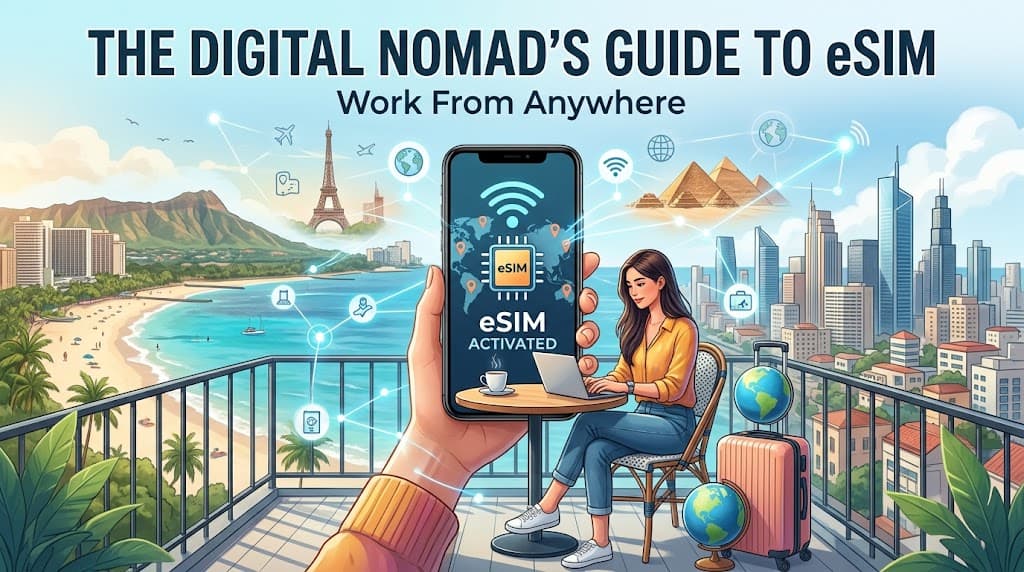
The Digital Nomad's Guide to eSIM: Work From Anywhere
Ah, the digital nomad life. Waking up to a new vista, the smell of exotic spices, and the hum of a foreign city – all while your laptop hums along, connecting you to clients and colleagues thousands of miles away. It's a dream many chase, but it comes with its own unique set of challenges, not least among them staying reliably connected.
In 2026, unreliable internet is no longer an option for the modern nomad. Dropped video calls, slow uploads, and missed deadlines can derail your journey faster than a canceled flight. This is where eSIM technology steps in, transforming the way we access mobile data globally. As your expert guide from FindMyEsim.io, a platform comparing 154+ providers across 203+ countries with 13225+ plans, I'm here to equip you with the knowledge to harness eSIMs for a truly boundless remote work experience.
Forget the days of hunting for local SIM cards, fumbling with tiny trays, or paying exorbitant roaming fees. eSIM is your passport to seamless, affordable, and flexible connectivity, wherever your wanderlust takes you. Let's dive deep into how you can optimize your eSIM strategy to conquer the world, one Wi-Fi-free coffee shop at a time.
Understanding eSIM for the Digital Nomad Lifestyle
Before we delve into advanced strategies, let's ensure we're all on the same page about the fundamentals. An eSIM, or embedded SIM, is a digital SIM card that allows you to activate a cellular plan from a carrier without needing a physical SIM card. It's built directly into your device, offering unparalleled flexibility.
For digital nomads, this means:
- Instant Connectivity: Purchase and activate a plan online, often within minutes, before you even land in a new country.
- No More SIM Swaps: Keep your primary physical SIM (if you have one) active for calls/texts while using an eSIM for data.
- Multiple Plans: Store several eSIM profiles on a single device, switching between them as you cross borders or find better deals.
- Reduced Roaming Costs: Access local rates virtually, avoiding your home carrier's expensive international roaming.
If you're new to eSIMs or need a refresher, I highly recommend checking out our comprehensive guide: What is an eSIM? The Complete Guide for 2026. Once you're ready to activate your first plan, our step-by-step instructions will be invaluable: How to Install an eSIM on iPhone & Android (Step-by-Step Guide for 2026).
Decoding Your Data Needs: The Remote Work Imperative
This is perhaps the most critical section for any working nomad. Underestimating your data needs is a common pitfall, leading to frustrating top-ups or being stranded without internet. Let's break down typical remote work data consumption.
Estimating Data for Video Calls
Video calls are the backbone of remote collaboration. Whether it's a client meeting on Zoom, a team catch-up on Google Meet, or a presentation on Microsoft Teams, these applications are data hogs. The quality of your video stream directly impacts consumption:
- Standard Definition (SD): Roughly 0.5 GB to 1 GB per hour.
- High Definition (HD): Around 1.5 GB to 3 GB per hour.
- Full HD (FHD): Can be 3 GB to 5 GB+ per hour.
Actionable Advice: If you have 3-4 hours of video calls per day, 5 days a week, you could easily consume 30-60 GB per month just on video calls. Always aim for HD quality for professionalism, so budget accordingly. You can often adjust video quality settings within the app if you're on a tight data plan.
General Remote Work Data Consumption
Beyond video calls, your daily workflow involves a myriad of other data-intensive activities:
- Email & Messaging (Slack, Teams Chat): Relatively low, perhaps a few hundred MBs per month.
- Web Browsing: Varies greatly. Heavy research or image-rich sites can add up. Estimate 5-10 GB/month.
- Cloud Storage (Google Drive, Dropbox, OneDrive): Uploading/downloading large files can quickly consume GBs. Factor in 10-20 GB+ if you frequently sync large projects.
- Software Updates: Background updates for your OS, apps, and security software can silently chew through data.
- VPN Usage: While a VPN encrypts your data, it can also add a slight overhead (5-15% increase in data usage) due to encryption and routing.
The "Buffer" Factor: Why You Need More Than You Think
It's not just work. As a digital nomad, you're also using data for navigation, social media, streaming music, looking up local restaurants, and staying in touch with family. These "personal" uses can easily add another 10-20 GB per month.
Expert Tip: Always over-estimate your data needs by at least 20-30%. It's far better to have too much data than to run out in the middle of a crucial meeting or while trying to find your way in a new city. A typical digital nomad actively working and living abroad should consider plans starting from 40-50 GB per month as a comfortable baseline, scaling up to 100 GB+ for heavy users or those without reliable Wi-Fi access.
Mastering Multi-Country Connectivity with eSIM
One of the most powerful advantages of eSIM for nomads is its ability to handle multiple countries with grace. No more scrambling for a new physical SIM every time you cross a border.
Regional vs. Single-Country Plans
- Single-Country Plans: Ideal if you plan to stay in one country for an extended period (weeks to months). They often offer the best local rates and highest data allowances for that specific region. FindMyEsim.io offers an extensive selection; you can easily Browse eSIM by Country to see what's available for your next destination.
- Regional Plans: A godsend for fast travelers or those embarking on multi-country tours (e.g., backpacking through Southeast Asia or a European road trip). These plans cover multiple countries under a single data allowance, saving you the hassle of buying a new eSIM for each border crossing. While the per-GB cost might be slightly higher than a dedicated single-country plan, the convenience is often worth it. Look for plans covering "Europe," "Asia," or "North America" on FindMyEsim.io.
Seamless Transitions
With eSIMs, transitions are genuinely seamless. You can purchase your next country's eSIM plan while still in your current location, activate it, and switch to it the moment you land. Your phone can store multiple eSIM profiles, allowing you to toggle between them effortlessly in your device settings. This means you can keep an active plan for your current country, and have a plan ready to go for your next destination, minimizing any connectivity downtime.
Actionable Advice: For complex itineraries, consider a regional plan for the bulk of your journey, and supplement with a high-data single-country eSIM for places where you plan extended stays or have particularly high data demands. Always check the validity period of your eSIM – some activate immediately upon purchase, others upon connection to a supported network, and some have a set activation window. Plan your purchases accordingly.
Cost Optimization Strategies: Stretching Your Budget Further
Connectivity costs can quickly add up if not managed properly. Here's how to be a savvy eSIM spender.
The Power of Comparison
This is where FindMyEsim.io truly shines. With 154+ providers and 13225+ plans, comparing options is crucial. Prices, data allowances, validity periods, and network speeds vary wildly. Don't settle for the first plan you see.
Actionable Advice: Use our platform to Compare eSIM Providers side-by-side. Filter by country, data amount, and validity to quickly find the best deals. Read reviews from other nomads to gauge reliability and customer service.
Long-Term vs. Short-Term Plans
- Short-Term (7-15 days): Excellent for quick trips, layovers, or bridging the gap until you can secure a long-term local solution. Often, these plans have a higher per-GB cost but offer flexibility.
- Long-Term (30+ days): Generally more cost-effective per GB, ideal for stays of a month or more. These are often the sweet spot for digital nomads who settle in a location for a while. Our guide to the Cheapest eSIM Plans in 2026: Your Ultimate Guide to Budget Connectivity will help you identify budget-friendly options.
Leveraging Wi-Fi Smartly
Even with abundant eSIM data, Wi-Fi is your friend. Offload heavy tasks like large file uploads/downloads, software updates, and high-quality streaming to secure Wi-Fi networks whenever possible. Co-working spaces, cafes, and your accommodation's Wi-Fi are prime candidates. Just ensure you're using a VPN on public Wi-Fi for security.
Data Rollover & Expiry
Most eSIM plans do not offer data rollover. When your plan expires, any unused data is typically lost. Be mindful of this when choosing validity periods. Some providers offer a grace period for topping up, but it's not universal.
Local SIM vs. eSIM for Extended Stays
For stays of several months or more in a single country, a local physical SIM (or a local eSIM from a domestic carrier) might still offer the absolute best value, especially if you need a local phone number for banking, local services, or two-factor authentication. However, the convenience of purchasing a global eSIM upfront and knowing you'll be connected immediately often outweighs the slight cost difference for the first month or two. Many digital nomads use an initial global eSIM, then switch to a local provider once settled.
Top Countries for Digital Nomad Connectivity (2026)
While eSIMs make connectivity easier everywhere, some countries simply offer a superior experience in terms of network speed, coverage, and affordability. This is crucial for maintaining productivity.
Factors Defining "Best"
- Network Coverage: Extensive 4G LTE and 5G availability, even outside major cities.
- Speed: High average download and upload speeds.
- Affordability: Competitive pricing for large data packages.
- eSIM Availability: Broad support from local and international eSIM providers.
- Infrastructure: Reliable power, co-working spaces, and general digital readiness.
Spotlight on High-Connectivity Hubs
Based on 2026 trends, these countries consistently rank high for digital nomads:
| Country | Key Connectivity Highlights (2026) | eSIM Plan Availability | Typical Cost for 30-Day, 20GB Plan (approx. USD) |
|---|---|---|---|
| Portugal | Excellent 5G in cities, strong 4G rural, good fiber optic infrastructure. | Very High (Multiple providers) | $25-40 |
| Estonia | Pioneer in digital services, widespread fast internet, strong 5G rollout. | High | $20-35 |
| Thailand | Reliable 4G/5G in tourist hubs (Bangkok, Chiang Mai, Phuket), affordable plans. | Very High | $15-30 |
| Mexico | Strong 4G/5G in major cities (Mexico City, Guadalajara), expanding coverage. | High | $20-35 |
| Colombia | Improving infrastructure, good 4G in major cities (Medellín, Bogotá), very affordable. | Medium to High | $10-25 |
| South Korea | World-leading 5G, incredibly fast and reliable, though slightly higher cost. | High | $35-50 |
Navigating Less-Connected Regions
What if your adventure takes you off the beaten path? Even in regions with less robust infrastructure, eSIMs still offer the best chance of connectivity. Here's how to prepare:
- Research Thoroughly: Before you go, check coverage maps of local carriers (often available on our provider pages) that your chosen eSIM provider uses.
- Download Offline Maps & Content: Ensure you have critical information accessible without internet.
- Portable Hotspot: Your phone can act as a hotspot for your laptop, but be mindful of battery drain and data consumption.
- Satellite Communicators (Extreme Cases): For truly remote work, consider a satellite messenger or internet device as a last resort.
Actionable Advice: Always check the specific country page on FindMyEsim.io to see local network partners and user reviews before committing to a plan, especially for less-traveled destinations.
Long-Term vs. Short-Term eSIM Plan Strategies
Matching your eSIM plan's duration to your travel style is key to efficiency and cost savings.
The Short-Term Sprint (1-15 days)
This strategy is perfect for:
- Transiting: Need data for a few days between long flights or during a layover.
- Weekend Trips: A quick getaway where you still need to stay connected for work.
- Initial Arrival: Getting connected immediately upon arrival before you decide on a longer-term solution or local SIM.
- Low Data Users: If you rely heavily on Wi-Fi and only need a small data buffer.
These plans are typically 1GB-10GB for 7-15 days. They are convenient but often have a higher per-GB cost.
The Long-Term Marathon (30+ days)
This is the workhorse for most digital nomads who settle in a location for a month or more. These plans typically offer:
- Better Value: Lower per-GB cost compared to short-term plans.
- Higher Data Allowances: Often ranging from 20GB to unlimited data.
- Extended Validity: 30, 60, or even 90 days.
Actionable Advice: If you know you'll be in a country for 3 weeks, a 30-day plan is usually more economical than two 15-day plans, even if you don't use the full 30 days. Always compare the total cost and data allowance.
Hybrid Approaches
Many nomads successfully combine strategies:
- Regional Starter + Local Long-Term: Use a regional eSIM for the first week or two of a multi-country trip, then purchase a dedicated long-term eSIM or local physical SIM once you settle in a specific country.
- Data Buffer + Wi-Fi Reliance: Purchase a smaller, cheaper eSIM plan for essential tasks (navigation, messaging) and rely on Wi-Fi for all heavy lifting. This works best if you have guaranteed access to reliable Wi-Fi.
- Primary eSIM + Backup eSIM: Always have a small, low-cost eSIM from a different provider or network as a backup in case your primary eSIM experiences issues or runs out of data unexpectedly.
Actionable Advice: Regularly review your data usage (most phones have built-in trackers). If you consistently run out, upgrade your next plan. If you consistently have data left over, consider a smaller, cheaper plan.
Practical Tips for the Savvy eSIM Nomad
- Keep Your Phone Unlocked: This is non-negotiable. Your phone must be unlocked to use eSIMs from various providers.
- Monitor Data Usage Religiously: Most smartphones have built-in data usage trackers. Check it weekly to stay on top of your consumption.
- Understand Fair Usage Policies (FUP): "Unlimited" data often comes with an FUP, meaning speeds might be throttled after a certain amount of data is consumed. Read the fine print.
- Download Before You Go: Maps, movies, podcasts, and large work files can be downloaded over Wi-Fi before you head out, saving valuable cellular data.
- Disable Auto-Play and Background App Refresh: These settings can silently consume data. Adjust them in your phone's settings.
- Leverage Wi-Fi Calling: If your home number is important, ensure your phone supports Wi-Fi calling. With an active eSIM for data, you can often make and receive calls on your primary number over Wi-Fi, even without a physical SIM for that number.
- Always Have a Backup Plan: Whether it's a small secondary eSIM, some emergency credit on your home SIM for data, or knowing the nearest Wi-Fi spot, never be completely reliant on a single connection.
- Explore Global/Regional eSIMs for Flexibility: For truly global nomads, consider a multi-country or even global eSIM plan that covers a vast number of destinations. While often pricier per GB, the convenience of never having to think about a new eSIM is priceless for some. You can explore these options by looking at providers that offer extensive country coverage on FindMyEsim.io.
Conclusion: Your World, Connected
The digital nomad lifestyle is about freedom, exploration, and the ability to work from anywhere. In 2026, eSIM technology is the invisible thread that weaves this dream into a tangible reality. By understanding your data needs, strategizing your plan purchases, and leveraging platforms like FindMyEsim.io, you can ensure you're always connected, productive, and ready for whatever adventure comes next.
With 154+ providers and 13225+ plans at your fingertips, FindMyEsim.io is your ultimate companion in navigating the complex world of international connectivity. Stop worrying about your internet and start focusing on the incredible experiences that await you. Happy travels, and happy working!
Frequently Asked Questions About eSIM for Digital Nomads
How much data do I really need for remote work?
For a typical digital nomad engaged in remote work, we recommend budgeting at least 40-50 GB per month as a comfortable baseline. This accounts for several hours of video calls, regular browsing, email, messaging, cloud syncing, and personal use. If you have extensive video calls, large file transfers, or stream a lot, consider 70-100 GB+ per month. Always monitor your usage and adjust your next plan accordingly.
Can I use multiple eSIMs at once?
Yes, most modern eSIM-compatible phones (like recent iPhones, Google Pixels, and Samsung Galaxies) support Dual SIM Dual Standby (DSDS) functionality. This means you can have two active SIMs simultaneously – for example, a physical SIM for your home number and an eSIM for data in your current country, or two eSIMs active at once. Your device can store many eSIM profiles, allowing you to switch between them as needed.
Is eSIM always cheaper than a local physical SIM?
Not always, but often. For short to medium stays (up to a few months), an eSIM from a global provider is frequently more convenient and competitively priced than navigating local SIM card purchases. For very long stays (many months to a year) in a single country, a local physical SIM or a local eSIM from a domestic carrier might offer slightly better value, especially if you need a local phone number. However, the ease of activation and flexibility of eSIMs often outweigh minor price differences for nomads constantly on the move.
What if my phone doesn't support eSIM?
If your phone doesn't support eSIM (typically older models), you'll need to rely on traditional physical SIM cards. This means buying a local SIM in each country you visit, or using international roaming from your home provider (which is usually very expensive for data). Consider upgrading to an eSIM-compatible device if you plan to continue the digital nomad lifestyle, as it offers significant advantages in convenience and cost.
How do I choose the best eSIM provider?
Choosing the best provider depends on your specific needs: the country you're visiting, the amount of data you need, the validity period, and your budget. FindMyEsim.io is designed precisely for this. Use our comparison tools to filter plans by country, data, and duration. Look at provider ratings, read user reviews, and check which local networks the eSIM provider uses for coverage and speed. For example, if you're going to Thailand, you might compare plans from providers like Airalo, Holafly, or GigSky, checking their specific offerings for that country.
FindMyEsim Editorial
eSIM Experts
The FindMyEsim team compares eSIM plans from 40+ providers to help travelers stay connected. We test, review, and analyze pricing so you can find the best deal for every destination.
Find the perfect eSIM for your next trip
Compare plans from 40+ providers across 170+ countries
Compare eSIM Plans