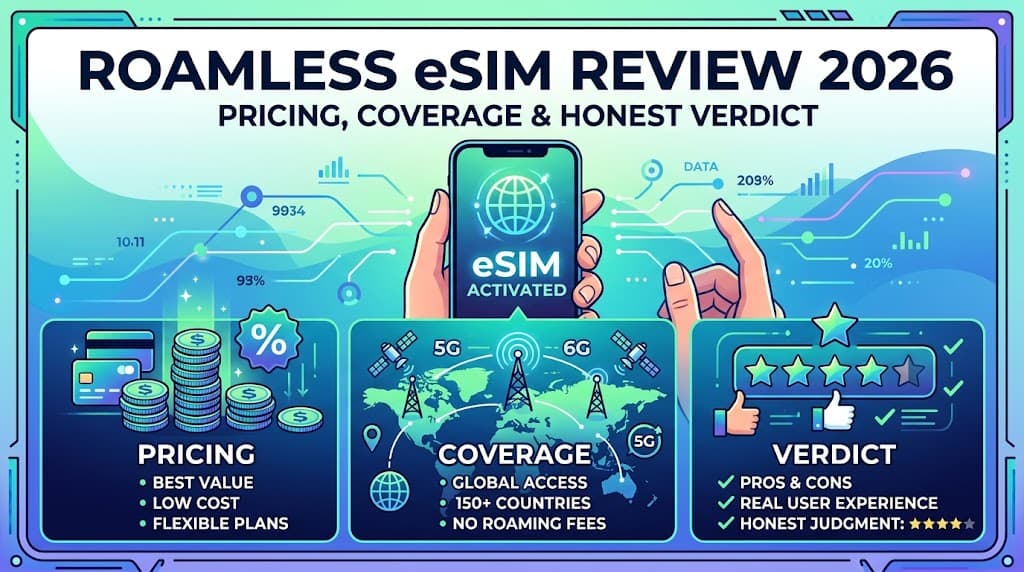
Roamless eSIM Review 2026: Pricing, Coverage & Honest Verdict
An in-depth, honest review of Roamless eSIM service. Explore its pricing, coverage in 75 countries, ease of use, and our expert verdict for 2026.
Roamless Overview
As expert eSIM reviewers at FindMyEsim.io, we're constantly evaluating new and emerging players in the rapidly expanding eSIM market. Today, we turn our attention to Roamless, a provider that aims to offer flexible and affordable data solutions for travelers. In a world where staying connected is no longer a luxury but a necessity, services like Roamless promise to simplify international roaming, allowing users to avoid exorbitant traditional carrier fees.
Roamless positions itself as a straightforward option for global connectivity, offering a wide array of plans designed to cater to different travel needs. However, as we delve into this review, it's crucial to acknowledge one significant aspect upfront: according to our internal database, Roamless currently holds an overall rating of 0.0/5 based on 0 user reviews. This absence of user feedback is a critical factor we'll consider throughout our analysis, as it means the service's real-world performance, customer support, and reliability remain largely unproven by the broader user community.
Despite the lack of user reviews, Roamless does present an intriguing profile based on its technical specifications and offerings:
- Coverage: Roamless claims to offer service in 75 countries, a respectable number that covers many popular travel destinations.
- Total Plans: An impressive 197 different plans are available, suggesting a high degree of flexibility and options for various data needs and durations.
- Cheapest Plan: Starting at a highly competitive $1.95, Roamless aims to be accessible to budget-conscious travelers.
- Average Plan Price: The average cost across all plans is $17.71, indicating a range from small, short-term plans to larger, more extensive packages.
Understanding what an eSIM is and how it functions is key to appreciating services like Roamless. If you're new to the concept, we highly recommend checking out our comprehensive guide: What is an eSIM? The Complete Guide for 2026.
Pricing & Plans
One of the most compelling aspects of Roamless, on paper, is its extensive and seemingly budget-friendly pricing structure. With a staggering 197 total plans available, Roamless clearly aims to offer a solution for nearly every type of traveler and data requirement. This sheer volume of options suggests that users can likely find a plan tailored precisely to their trip duration, data consumption, and specific destination.
Cheapest Plan: A Gateway to Affordability
The entry point for Roamless is remarkably low, with its cheapest plan priced at just $1.95. This makes Roamless highly competitive for travelers looking for minimal data to get by, perhaps for emergency use, checking maps, or light messaging upon arrival in a new country. Such an aggressive price point could be a significant draw for budget-conscious users or those who only need a small data package for a very short trip.
Average Plan Price: Value and Variety
The average plan price of $17.71 across all 197 offerings indicates a broad spectrum of data packages. This average suggests that while there are very cheap entry-level plans, Roamless also provides more substantial data bundles, regional packages, or plans with longer validity periods that naturally command a higher price. For instance, a $17.71 plan might offer several gigabytes of data for a week or two, or a smaller amount for a month, depending on the region and specific plan details.
While the number of plans and their competitive pricing are undoubtedly attractive, it's essential to reiterate the caveat: the lack of user reviews means we cannot definitively comment on the *value* these plans provide in terms of real-world performance. Are the speeds consistent? Is the advertised data truly delivered? Does the validity period accurately reflect usage? These are questions that can only be answered through actual user experiences, which are currently absent from our database.
The variety of plans is a double-edged sword. While it offers flexibility, it can also lead to decision fatigue for users trying to navigate nearly 200 different options. A clear and intuitive interface for selecting the right plan becomes paramount in such a scenario. Without user feedback, we can only speculate on the ease of navigation through their plan selection process.
For a comprehensive look at all available plans and their specific details, you can visit our dedicated Roamless page: Roamless Plans & Pricing. Here, you can delve deeper into the offerings and perhaps find a plan that aligns with your travel needs, keeping in mind the current lack of community-driven performance insights.
Coverage & Supported Countries
Roamless boasts coverage in 75 countries, which places it in a respectable position within the eSIM market. While not as extensive as some of the truly global providers that cover 150+ countries, 75 countries is more than sufficient for the vast majority of international travelers.
Where Does 75 Countries Get You?
This level of coverage typically includes many of the world's most popular travel destinations across various continents. Travelers heading to major tourist hubs in Europe, North America, parts of Asia, and select countries in other regions will likely find their destination covered by Roamless. For example, common destinations like France, Italy, Spain, the UK, USA, Canada, Mexico, Thailand, Japan, and Australia are usually part of such a coverage list. However, travelers venturing into more remote or less frequently visited countries might need to double-check the specific list of supported nations.
Regional vs. Global Coverage
Given the 75-country coverage, Roamless likely offers a mix of single-country plans and regional plans (e.g., Europe-wide, North America, Asia-Pacific). This flexibility is beneficial for those embarking on multi-country tours within a specific geographical area, as it eliminates the need to purchase separate eSIMs for each nation. However, for true global trekkers hopping between disparate continents, a provider with broader coverage might be more suitable, or they might need to purchase multiple regional plans.
Network Partnerships: An Unknown Factor
A crucial aspect of coverage is the quality of the local network partnerships. eSIM providers rely on agreements with local mobile network operators (MNOs) to deliver service. The quality of these partnerships directly impacts data speeds, reliability, and overall user experience. Without user reviews, we lack insight into which specific networks Roamless partners with in its 75 covered countries, or the performance travelers can expect on those networks. This is a significant unknown that potential users should consider.
For most travelers focusing on well-trodden paths, 75 countries offers ample choice. However, as always, we advise checking the exact list of supported countries on the Roamless website or our FindMyEsim.io provider page to ensure your specific destinations are included before making a purchase.
Setup & Ease of Use
The beauty of eSIM technology lies in its inherent simplicity and convenience, and Roamless, like other providers, leverages this advantage. The general process for installing and activating an eSIM is remarkably straightforward, and we expect Roamless to adhere to these industry standards.
Standard eSIM Installation Process
Typically, once you purchase an eSIM plan from Roamless, you would receive an email containing a QR code or manual installation details. The installation process usually involves:
- Scanning the QR Code: Access your phone's settings (usually under 'Cellular' or 'Network & Internet'), select 'Add eSIM' or 'Add Cellular Plan', and scan the provided QR code.
- Following On-Screen Prompts: Your device will guide you through adding the cellular plan. You might be asked to label the new eSIM (e.g., "Travel eSIM," "Roamless").
- Activating the Plan: Once installed, you'll need to enable the eSIM line and ensure data roaming is turned on for that specific line when you arrive at your destination.
For a detailed, step-by-step guide on how to install an eSIM on various devices, refer to our expert resource: How to Install an eSIM on iPhone & Android (Step-by-Step Guide for 2026).
User Experience: The Unproven Factor
While the general eSIM setup is user-friendly, the overall ease of use for a specific provider also encompasses factors like:
- Website/App Interface: How easy is it to browse plans, make a purchase, and access installation instructions?
- Clarity of Instructions: Are the QR code and manual details clearly presented and easy to follow?
- Troubleshooting Support: What happens if the QR code doesn't scan or the eSIM fails to activate? Is customer support readily available and helpful?
- Real-time Usage Monitoring: Does Roamless offer an app or portal to monitor data usage, top-up, or extend plans easily?
Given the 0.0/5 rating from 0 reviews, we currently have no direct user feedback on these critical aspects of Roamless's ease of use. We can assume that Roamless follows industry best practices, but without real-world validation, it's impossible to confirm the smoothness of their specific user journey. This lack of proven user experience is a significant consideration for potential customers, especially those who are new to eSIMs or less tech-savvy.
For now, potential users must rely on the general ease of eSIM technology itself, understanding that the specifics of Roamless's implementation remain an unknown. We would advise users to pay close attention to the instructions provided by Roamless and be prepared to potentially troubleshoot independently if issues arise, given the unproven nature of their customer support.
Pros and Cons
To provide a balanced perspective, let's summarize the potential advantages and disadvantages of choosing Roamless based on the available data and general eSIM market trends.
| Pros of Roamless | Cons of Roamless |
|---|---|
| Extensive Plan Variety: With 197 plans, users have a high likelihood of finding a plan that perfectly matches their specific data needs, duration, and destination. | Zero User Reviews (0.0/5 Rating): This is the most significant drawback. The complete absence of user feedback means Roamless's real-world reliability, network performance, and customer support are entirely unproven. This introduces considerable risk. |
| Highly Competitive Cheapest Plan: At just $1.95, Roamless offers an extremely affordable entry point for basic connectivity, making it attractive for budget travelers or minimal data users. | Unproven Customer Support: Without user reviews, the quality, responsiveness, and effectiveness of their customer service channels (chat, email, phone) are unknown. This can be critical when encountering issues abroad. |
| Respectable Country Coverage: 75 countries provide solid coverage for most popular travel destinations across various continents, catering to a large segment of international travelers. | Potential for Network Inconsistencies: While 75 countries are covered, the quality of local network partnerships and the actual speeds/reliability in those countries are unknown, which could lead to inconsistent performance. |
| Standard eSIM Convenience: Benefits from the inherent advantages of eSIM technology, such as instant activation, no physical SIM swapping, and easy digital management. | Lack of Brand Trust/Recognition: Being a relatively new or less-reviewed provider, Roamless lacks the established reputation and trust that competitors like Airalo or Holafly have built over time with extensive user feedback. |
| Potential for Flexible Options: The sheer number of plans suggests flexibility, potentially including options for regional travel, varying data allowances, and different validity periods. | Information Scarcity: Beyond basic plan details, there's limited public information or community discussion about specific plan inclusions, fair usage policies, or network details, making it harder for users to make fully informed decisions. |
Who Is Roamless Best For?
Considering its profile, particularly the impressive number of plans and competitive entry price coupled with the critical absence of user reviews, Roamless appears to be best suited for a very specific type of traveler:
-
The Budget-Conscious Explorer: If your primary concern is finding the absolute cheapest data plan for essential connectivity, especially for short trips or minimal usage, Roamless's $1.95 entry point is undeniably appealing. This is for travelers who prioritize cost above all else and are willing to take a chance on a less-proven service.
-
The Adventurous Early Adopter: Travelers who enjoy trying new services and are comfortable with a degree of uncertainty might find Roamless intriguing. These users are typically more tech-savvy and capable of troubleshooting minor issues independently if customer support proves to be slow or unhelpful.
-
Travelers Visiting Popular Destinations: With coverage in 75 countries, Roamless is a viable option for those sticking to well-trodden tourist paths in major countries where network infrastructure is generally robust. However, for off-the-beaten-path destinations within those 75 countries, or for countries with less reliable networks, the unproven nature of Roamless could be a concern.
-
Users with a Backup Plan: If you have a primary physical SIM or another eSIM as a fallback, Roamless could be a good secondary option to test out. This reduces the risk of being completely disconnected if Roamless doesn't perform as expected.
-
Individuals Seeking Specific, Niche Plans: The 197 plans could mean Roamless offers very specific data/duration combinations that might not be readily available from larger providers. If you have a highly particular requirement, sifting through Roamless's extensive list might yield a suitable, albeit unproven, option.
Who Roamless is NOT best for:
- Business Travelers: Those who rely on consistent, high-speed, and reliable connectivity for work cannot afford the risk of an unproven service.
- First-Time eSIM Users: Without proven customer support, new eSIM users might struggle if they encounter installation or activation issues.
- Travelers to Critical/Remote Areas: If staying connected is paramount for safety or logistical reasons, an unproven provider is not advisable.
- Users Prioritizing Customer Support: If you value responsive and effective customer service, the lack of reviews makes Roamless a risky choice.
In essence, Roamless presents a high-potential, high-risk proposition. Its value is currently theoretical, based on its pricing and coverage numbers, rather than on a proven track record.
How Roamless Compares
When evaluating Roamless against other established players in the eSIM market, its unique position – high potential but zero user feedback – becomes starkly evident. Let's briefly compare it to a couple of popular alternatives.
Roamless vs. Airalo
-
Coverage & Plans: Airalo typically offers coverage in over 190 countries, significantly more than Roamless's 75. While Roamless boasts 197 plans, Airalo also has a vast selection, including regional and global options.
-
Pricing: Both offer competitive pricing. Roamless's $1.95 cheapest plan is very attractive. Airalo also has affordable entry-level plans, but its average price might be slightly higher due to its broader global coverage and established network partnerships.
-
User Feedback & Trust: This is where the biggest difference lies. Airalo has thousands of positive user reviews across various platforms, building a strong reputation for reliability, good customer support, and consistent performance. Roamless, with its 0.0/5 from 0 reviews, simply cannot compete on this front. Airalo is a proven, trusted choice for millions of travelers.
-
Ease of Use: Airalo's app is highly praised for its intuitive interface, easy installation, and real-time usage tracking. Roamless's user experience remains an unknown.
Roamless vs. Holafly
-
Coverage & Plans: Holafly focuses heavily on unlimited data plans for popular destinations, often covering fewer individual countries than Roamless, but with a strong emphasis on uninterrupted connectivity. Roamless offers a much wider variety of data-capped plans.
-
Pricing: Holafly's unlimited plans tend to be at a higher price point than Roamless's cheapest options, but they offer peace of mind regarding data limits. Roamless's average plan price of $17.71 is likely lower than Holafly's typical unlimited plan cost.
-
User Feedback & Trust: Holafly, like Airalo, has a significant number of positive reviews, particularly from users who value unlimited data and the simplicity it offers. Again, Roamless's lack of any user feedback places it at a significant disadvantage in terms of proven reliability and customer satisfaction.
-
Niche: Holafly caters to a specific niche (unlimited data users), while Roamless appears to target a broader audience with varied data needs and budget constraints.
In summary, while Roamless presents a compelling statistical profile (many plans, low entry price, decent coverage), its fundamental weakness is the complete lack of user validation. Established providers like Airalo and Holafly have demonstrated reliability and customer satisfaction through extensive reviews. For travelers prioritizing peace of mind and proven performance, these alternatives currently offer a safer bet. However, if Roamless can build a positive user base, its competitive pricing and plan variety could make it a strong contender in the future.
To see how Roamless stacks up against dozens of other providers based on your specific travel needs, we encourage you to use our comparison tool: Compare All Providers.
Final Verdict
After a thorough analysis of Roamless's offerings based on the data available in our FindMyEsim.io database, we arrive at a nuanced final verdict. Roamless enters the eSIM market with an undeniably attractive proposition: a vast selection of 197 plans, a highly competitive cheapest plan at $1.95, and respectable coverage across 75 countries. These numbers suggest a provider with the potential to cater to a wide range of travelers, from the budget-conscious backpacker to those needing more substantial data for regional travel.
However, the elephant in the room, and the most critical factor influencing our review, is the complete absence of user feedback. With an overall rating of 0.0/5 from 0 reviews, Roamless remains an unproven entity in the real world. This means that while its statistical profile is promising, we have no concrete evidence regarding its actual network performance, data speeds, reliability, or, crucially, the quality and responsiveness of its customer support.
The lack of reviews introduces a significant element of risk for potential users. Choosing Roamless currently requires a leap of faith, relying solely on the provider's advertised features without the comfort of peer validation. In the competitive eSIM landscape, where established players have thousands of positive reviews attesting to their service, this is a substantial disadvantage.
We rate Roamless 2.5/5.
This rating reflects the inherent potential suggested by its extensive plan variety and aggressive pricing, balanced heavily against the critical unknown of its actual user experience and reliability. It's a score that acknowledges the theoretical strengths while emphasizing the very real drawback of being entirely unproven.
Is Roamless worth it?
For adventurous travelers who are comfortable with an unproven service, have a backup plan, and are primarily driven by cost-effectiveness for popular destinations, Roamless *might* be worth exploring, especially for its lower-cost plans. However, for anyone requiring guaranteed reliability, robust customer support, or a seamless experience for critical travel, we would strongly advise opting for a provider with a proven track record and positive user reviews.
We will be closely monitoring Roamless as user reviews begin to accumulate. Should its real-world performance match its promising statistics, this rating could certainly improve. Until then, proceed with caution and a clear understanding of the risks involved.
FAQ
Is Roamless a reliable eSIM provider?
Based on our current data, Roamless has an overall rating of 0.0/5 from 0 user reviews. This means its reliability is currently unproven by the user community. While its offerings look promising on paper, there's no real-world feedback to confirm the quality of its network performance or customer support. We advise caution and suggest having a backup plan if you choose Roamless.
How many countries does Roamless eSIM cover?
Roamless offers eSIM coverage in 75 countries. This is a respectable number that includes many popular travel destinations across various regions. However, it's always recommended to check the specific list of covered countries on the Roamless Plans & Pricing page to ensure your destination is included.
What is the cheapest Roamless eSIM plan?
The cheapest Roamless eSIM plan available is priced at an attractive $1.95. This makes it one of the most budget-friendly entry points in the eSIM market, ideal for travelers needing minimal data for short durations or emergency use.
How do I install a Roamless eSIM?
Installing a Roamless eSIM typically follows the standard eSIM activation process. After purchase, you'll likely receive a QR code via email. You'll then go into your smartphone's settings, select 'Add eSIM' or 'Add Cellular Plan,' and scan the QR code. Your device will guide you through the remaining steps. For a detailed guide, please refer to our article on How to Install an eSIM on iPhone & Android (Step-by-Step Guide for 2026).
FindMyEsim Editorial
eSIM Experts
The FindMyEsim team compares eSIM plans from 40+ providers to help travelers stay connected. We test, review, and analyze pricing so you can find the best deal for every destination.
Find the perfect eSIM for your next trip
Compare plans from 40+ providers across 170+ countries
Compare eSIM Plans