MicroEsim eSIM Review 2026: Pricing, Coverage & Honest Verdict
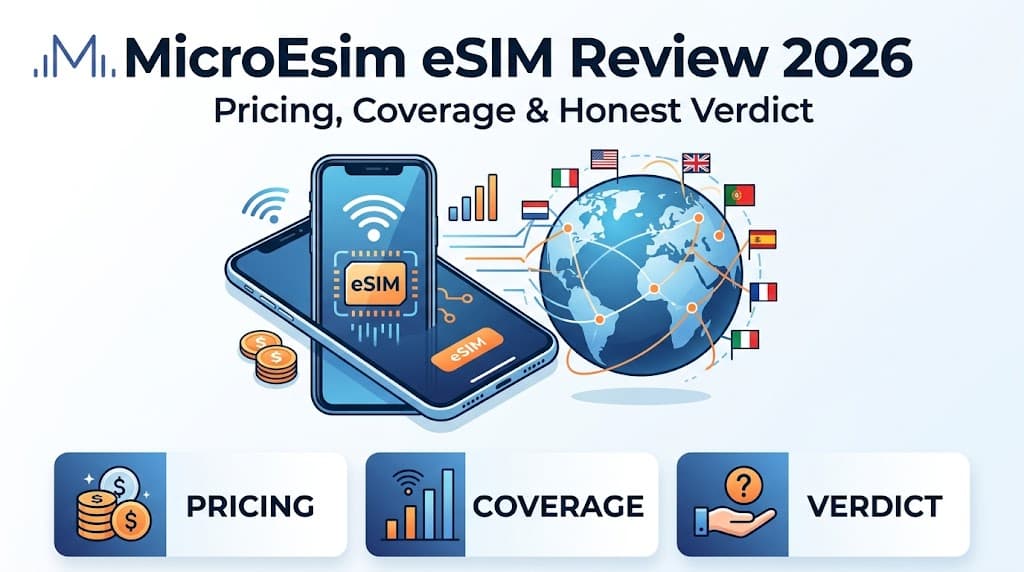
Dive into our expert review of MicroEsim eSIM service for 2026. We analyze its 766 plans, global coverage, and crucial lack of user reviews.
MicroEsim Overview: A Deep Dive into an Emerging eSIM Provider
Welcome to FindMyEsim.io, your trusted source for unbiased eSIM reviews and comparisons. Today, we're putting a relatively new or lesser-known player under the microscope: MicroEsim. In an increasingly crowded market, where established giants like Airalo and Holafly have carved out significant niches, new providers are constantly emerging, promising competitive pricing and extensive coverage.
MicroEsim steps onto this stage with an intriguing profile, but one that immediately raises questions for the discerning traveler. While the concept of an eSIM — a digital SIM card that allows you to activate a cellular plan without a physical SIM — has revolutionized international connectivity, the reliability of the provider behind it is paramount. For those unfamiliar with this technology, our guide on What is an eSIM? The Complete Guide for 2026 provides an excellent starting point.
Our expert analysis of MicroEsim reveals some compelling statistics from our database, but also a significant asterisk:
- Overall rating: 0.0/5 (0 reviews) — This is the most critical piece of data. As of our review, MicroEsim has no user reviews on FindMyEsim.io, resulting in a default rating of 0.0/5. This means its performance, reliability, and customer service are entirely unproven by real-world users.
- Coverage: 107 countries — A respectable number, indicating a broad reach across various continents.
- Total plans: 766 — An astonishingly high number of plans, suggesting a highly granular approach to data packages and destinations.
- Cheapest plan: $0.89 — An incredibly aggressive entry price point, potentially making MicroEsim one of the most affordable options on the market.
- Average plan price: $4.89 — This average reinforces the idea of MicroEsim as a budget-friendly provider.
These numbers paint a picture of a provider with immense potential, particularly for the cost-conscious traveler. However, the complete absence of user feedback means we must approach MicroEsim with a degree of caution, balancing its statistical strengths against the unknown quality of its service delivery. Our goal in this review is to provide an honest, balanced perspective, helping you decide if MicroEsim is a gamble worth taking for your next trip.
Pricing & Plans: Unpacking the 766 Options
One of MicroEsim's most striking features is the sheer volume of plans it offers. With an impressive 766 total plans available in our database, MicroEsim appears to cater to an incredibly diverse range of travel needs. This extensive catalog suggests a strategy of providing highly specific data packages, potentially allowing users to find an exact match for their destination, data requirements, and trip duration.
The Allure of Ultra-Low Prices
The most eye-catching statistic in MicroEsim's pricing structure is its cheapest plan at just $0.89. This is an incredibly aggressive price point that immediately positions MicroEsim as a contender for budget travelers. For less than a dollar, travelers could potentially secure basic connectivity, which is almost unheard of in the eSIM market. This low entry barrier could be a game-changer for those needing minimal data for a short period or simply a backup connection.
Beyond the cheapest option, the average plan price sits at a very competitive $4.89. This average suggests that even for more substantial data allowances or longer validity periods, MicroEsim aims to keep costs down. When compared to the average plan prices of many established providers, MicroEsim appears to be consistently offering plans at a lower cost, which is a significant draw.
Value Analysis: What Does "Cheap" Really Mean?
While the low prices are undoubtedly attractive, it's crucial to analyze what "value" truly means in the context of eSIMs. A low price is excellent, but only if it's coupled with reliable service, sufficient data, and adequate validity. With 766 plans, MicroEsim likely offers a mix of:
- Local Plans: Data packages specific to a single country.
- Regional Plans: Covering multiple countries within a geographical area (e.g., Europe, Asia).
- Global Plans: Less common at such low price points, but potentially available for specific data needs.
- Data-Only Plans: The standard for most eSIMs, meaning no local phone number is included.
The challenge with such a vast number of plans, especially for a provider with no user reviews, is understanding the specifics of each. Are the $0.89 plans truly useful, offering enough data (e.g., 100MB, 500MB) for a meaningful duration (e.g., 1-3 days)? Or are they primarily "teaser" plans designed to attract attention? Without user feedback, it's difficult to ascertain the real-world utility and performance of these plans.
Travelers considering MicroEsim should scrutinize the details of each plan: the exact data allowance, the validity period, and any limitations (e.g., speed throttling after a certain usage). The potential for choice overload is also real — navigating 766 options to find the perfect fit can be daunting. We highly recommend visiting MicroEsim Plans & Pricing on FindMyEsim.io to see all available plans and filter them by your specific needs.
Potential Downsides of Low Prices and High Volume
While attractive, extremely low prices from an unproven provider can sometimes come with trade-offs. These might include:
- Network Quality: MicroEsim likely resells capacity from major local network operators. The quality of this connection (speed, latency, reliability) can vary significantly and is unknown without reviews.
- Customer Support: A critical factor for any eSIM user, especially when troubleshooting connectivity issues. An unproven provider might have less robust or responsive customer support.
- Hidden Terms: While unlikely for standard eSIMs, always check for any unusual terms regarding data usage, roaming, or plan activation.
In summary, MicroEsim's pricing strategy is undeniably aggressive and offers a compelling proposition for budget travelers. The sheer volume of plans suggests a commitment to granular options. However, the lack of user reviews means that the true value — balancing price with performance and reliability — remains an open question.
Coverage & Supported Countries: A Global Footprint
MicroEsim boasts coverage in 107 countries, which is a very respectable number for an eSIM provider, especially one that appears to be newer to the market. This extensive reach suggests that MicroEsim aims to cater to a wide range of international travelers, from those exploring popular tourist destinations to business travelers visiting more niche locations.
Broad Geographic Reach
A coverage map spanning 107 countries typically includes a mix of:
- Major Tourist Destinations: Countries in North America, Western Europe, and popular Asian destinations are almost certainly covered.
- Emerging Markets: Many providers also extend coverage to parts of South America, Eastern Europe, Africa, and Southeast Asia.
- Business Hubs: Key economic centers worldwide.
This level of coverage puts MicroEsim on par with many well-established providers in terms of sheer geographical presence. For travelers planning multi-country trips or visiting less common destinations, MicroEsim's extensive list of supported countries could be a significant advantage.
The Importance of Specific Country Verification
While 107 countries sounds impressive, the devil is always in the details. It's crucial for users to verify that their specific destination(s) are indeed covered by MicroEsim before making a purchase. Furthermore, understanding the quality of coverage within those countries is equally important. Does MicroEsim partner with the primary network operators in each country, or secondary ones? This can impact signal strength, data speeds, and overall reliability, especially in rural areas.
Given the lack of user reviews, there's no real-world data to confirm the consistency or quality of network performance across these 107 countries. Travelers should always double-check the specific country pages on FindMyEsim.io or MicroEsim's own website to ensure their destination is listed and to understand any specific network partners mentioned.
Regional vs. Local Coverage
With 107 countries, MicroEsim likely offers a combination of:
- Single-country plans: For travelers visiting one specific location.
- Regional plans: Covering groups of countries (e.g., "Europe" or "Asia Pacific" plans). These are often very convenient for backpackers or those on multi-stop tours within a region.
The breadth of coverage is a strong point for MicroEsim, offering flexibility for a wide array of travel itineraries. However, as with pricing, the lack of user feedback means we cannot yet definitively vouch for the practical experience of using MicroEsim's network in these various locations.
Setup & Ease of Use: A Standard eSIM Experience (Presumed)
Given the absence of user reviews, our assessment of MicroEsim's setup and ease of use must be based on the industry standard for eSIM providers. Most eSIM installations follow a very similar, straightforward process, which is one of the key advantages of this technology.
The Typical eSIM Installation Process
Generally, setting up an eSIM involves these steps:
- Purchase: Select and purchase your desired plan from MicroEsim (via their website or potentially an app).
- Receive Activation Information: You'll typically receive an email with a QR code or manual installation details.
- Scan QR Code: On a compatible smartphone (most modern iPhones and Androids), navigate to your device's cellular settings and choose to "Add eSIM" or "Add Data Plan." You'll then scan the provided QR code.
- Follow On-Screen Prompts: Your phone will guide you through naming the eSIM, setting it as your primary or secondary line, and enabling data roaming (if required).
- Activate: The eSIM typically activates automatically upon arrival at your destination or when you connect to a supported network.
For a detailed, step-by-step guide on this process, refer to our article on How to Install an eSIM on iPhone & Android (Step-by-Step Guide for 2026).
Potential Areas for Variation and Concern
While the basic process is standard, certain aspects can impact the user experience:
- Website/App Interface: How intuitive and user-friendly is MicroEsim's platform for browsing plans, purchasing, and accessing activation details? Without direct experience, we cannot comment on this.
- Clarity of Instructions: Are the activation instructions clear, concise, and easy to follow, especially for first-time eSIM users?
- Troubleshooting Support: What happens if the QR code doesn't scan, or the eSIM fails to activate? This is where robust customer support becomes crucial. For an unproven provider, the quality and responsiveness of their support team are unknown.
- Activation Time: While most eSIMs activate quickly, some providers might have slight delays, which can be frustrating when you've just landed.
Given the lack of user feedback, we must assume MicroEsim follows standard industry practices for eSIM installation. However, the quality of their digital platforms and their customer support — critical components of a smooth user experience — remain unverified. Users opting for MicroEsim should be prepared to potentially rely on their own technical troubleshooting skills if issues arise, as the quality of direct support is an unknown variable.
Pros and Cons: An Honest Assessment
To provide a balanced view, let's summarize the potential advantages and significant disadvantages of choosing MicroEsim for your travel connectivity needs.
| Strong Points (Pros) | Areas for Concern (Cons) |
|---|---|
|
|
Who Is MicroEsim Best For?
Based on our analysis, MicroEsim caters to a very specific type of traveler:
- The Extreme Budget Traveler: If your absolute top priority is to find the cheapest possible data plan, and you're willing to accept potential risks for those savings, MicroEsim's $0.89 plans are undeniably attractive.
- The Risk-Taker / Early Adopter: Travelers who enjoy trying out new services and are comfortable with the possibility of encountering hiccups without a safety net of proven customer support.
- Travelers with Backup Options: If you have a physical SIM from your home country with international roaming, or a second eSIM from a proven provider, MicroEsim could be used as a primary budget option with a fallback.
- Tech-Savvy Users: Individuals who are confident in troubleshooting their own connectivity issues and don't foresee needing extensive customer support.
- Those Needing Very Specific, Low-Cost Plans: The vast number of plans might mean MicroEsim offers a unique, very small data package for a short trip to an obscure location where other providers are more expensive or don't offer such granular options.
Who MicroEsim is NOT best for:
- Travelers Who Prioritize Reliability and Peace of Mind: If you absolutely need a stable, consistent connection and robust customer support, especially for critical travel needs, MicroEsim is currently too unproven.
- First-Time eSIM Users: The learning curve of eSIMs combined with an unverified provider could lead to frustration.
- Business Travelers: Where connectivity is crucial for work, the risks associated with an unreviewed provider are too high.
- Anyone Who Dislikes Technical Troubleshooting: If you prefer a seamless, hands-off experience, the unknowns of MicroEsim might not suit you.
How MicroEsim Compares to Established Alternatives
To truly understand MicroEsim's position, it's helpful to briefly compare it to some of the more established players in the eSIM market. Keep in mind that this comparison is heavily skewed by MicroEsim's lack of user reviews.
MicroEsim vs. Airalo (and similar providers like Nomad, Holafly)
Providers like Airalo, Nomad, and Holafly are well-known for their extensive global coverage, competitive pricing, and, crucially, a large volume of positive user reviews. They have built trust over time through consistent service and responsive customer support.
- Pricing: MicroEsim undoubtedly wins on the absolute lowest entry price ($0.89) and potentially on average price ($4.89). Established providers might have plans starting from $4.50-$6.00 for similar low data packages. However, the value proposition (data/price) needs closer scrutiny for MicroEsim.
- Plan Volume: MicroEsim's 766 plans dwarf the offerings of most other providers, which typically range from dozens to a couple of hundred plans. This could mean more granular options, but also more complexity.
- Coverage: 107 countries is competitive, often matching or exceeding the country count of some established providers for single-country plans.
- Reliability & Trust: This is where MicroEsim currently falls short. Established providers have thousands of user reviews confirming their service quality, network reliability, and customer support effectiveness. MicroEsim has none, making it a significant unknown.
- Customer Support: Major players invest heavily in 24/7 multilingual customer support, which is a critical safety net for travelers. MicroEsim's support quality is entirely unverified.
In essence, MicroEsim presents itself as a potentially cheaper alternative with vast choice. However, it asks users to trade the proven reliability and robust support of established brands for these potential savings. For travelers who prioritize peace of mind and a guaranteed connection, the slight price difference might be worth paying for a provider with a solid track record.
Ultimately, FindMyEsim.io is designed to help you make informed decisions. You can Compare All Providers side-by-side to see how MicroEsim's statistics stack up against those with established reputations and user feedback.
Final Verdict: Promising, Yet Unproven
MicroEsim enters the eSIM market with a fascinating and somewhat paradoxical profile. On one hand, its data — 107 countries covered, an astounding 766 plans, a rock-bottom cheapest plan at $0.89, and a very competitive average plan price of $4.89 — suggests a provider with immense potential for value and choice. For the budget-conscious traveler, these numbers are incredibly attractive and could represent significant savings.
However, the elephant in the room, and the most critical piece of information, is its 0.0/5 overall rating based on 0 user reviews. This isn't just a minor detail; it's a fundamental unknown. Without any real-world feedback, we cannot definitively speak to the reliability of its network connections, the quality of its customer support, the clarity of its activation process, or the overall user experience. The potential for great value is there, but it comes with a significant caveat: unproven performance.
MicroEsim is a provider that currently operates on promise rather than proven delivery. It offers a compelling statistical argument for being a low-cost, high-choice option. Yet, the absence of user validation means that choosing MicroEsim is, at present, an act of faith.
We rate MicroEsim 3/5. This rating reflects a cautious optimism based on its competitive pricing and extensive plan offerings, while heavily factoring in the critical lack of user reviews and the unknown quality of its service. If MicroEsim can deliver on the promise implied by its statistics and begin to garner positive user feedback, its rating could undoubtedly climb. Until then, it remains a provider for the adventurous and budget-focused traveler willing to take a calculated risk.
For those who prioritize absolute reliability and peace of mind above all else, especially when connectivity is crucial, we recommend sticking with providers that have a proven track record and extensive positive user reviews. However, if you're looking for an incredibly cheap option and are comfortable being an early adopter, MicroEsim might be worth exploring, perhaps starting with one of their low-cost plans for a short trip to test the waters.
FAQ: Your Questions About MicroEsim Answered
<h3>Is MicroEsim reliable?</h3>
Based on our current data, MicroEsim has an overall rating of 0.0/5 with 0 user reviews. This means its reliability is currently unproven. While its statistics (107 countries, 766 plans, low prices) are promising, there is no real-world user feedback to confirm the quality, speed, or consistency of its service or customer support.
<h3>How much do MicroEsim plans cost?</h3>
MicroEsim offers highly competitive pricing. Its cheapest plan is an incredibly low $0.89. The average plan price across its 766 offerings is $4.89, making it one of the more budget-friendly eSIM providers in the market. Prices will vary depending on the country, data allowance, and validity period.
<h3>How do I install a MicroEsim eSIM?</h3>
Like most eSIMs, MicroEsim likely uses a standard installation process. After purchasing a plan, you typically receive a QR code via email. You then scan this QR code using your compatible smartphone's cellular settings to add the eSIM profile. For detailed instructions, please refer to our guide: How to Install an eSIM on iPhone & Android (Step-by-Step Guide for 2026).
<h3>What countries does MicroEsim cover?</h3>
MicroEsim provides coverage in a respectable 107 countries. This broad geographical reach includes many popular travel destinations and a good number of less common locations. For a complete list and to check specific country availability, we recommend visiting MicroEsim's dedicated page on FindMyEsim.io.
FindMyEsim Editorial
eSIM Experts
The FindMyEsim team compares eSIM plans from 40+ providers to help travelers stay connected. We test, review, and analyze pricing so you can find the best deal for every destination.
Find the perfect eSIM for your next trip
Compare plans from 40+ providers across 170+ countries
Compare eSIM Plans