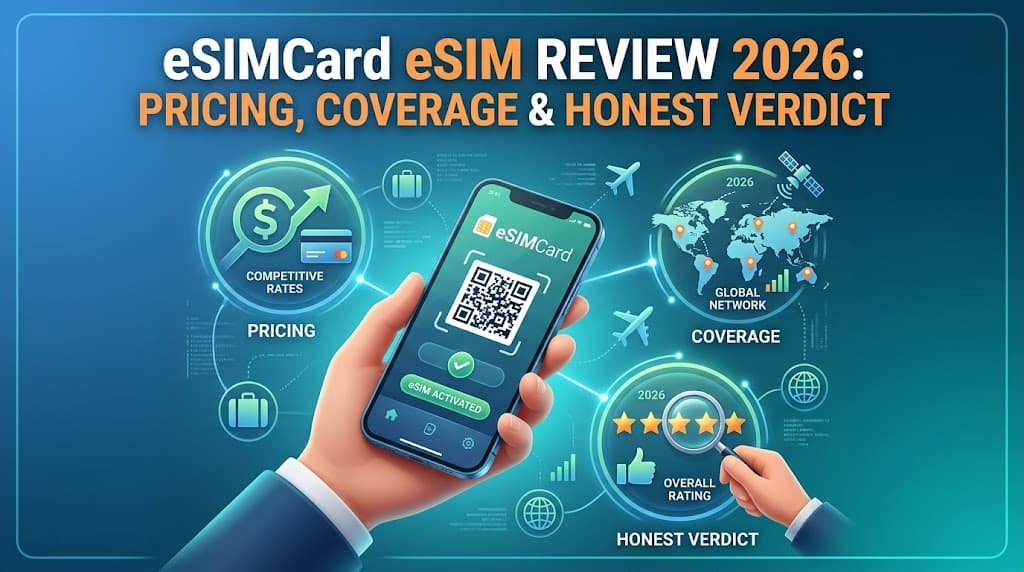
eSIMCard eSIM Review 2026: Pricing, Coverage & Honest Verdict
Dive into our expert review of eSIMCard's service, analyzing its 335 plans, 117-country coverage, and budget-friendly options, alongside the critical lack of user feedback.
eSIMCard Overview
Welcome to FindMyEsim.io, your trusted source for unbiased eSIM reviews and comparisons. Today, we're putting a spotlight on eSIMCard, a provider that has recently entered the competitive eSIM landscape. As the world increasingly embraces the convenience of digital SIMs, new players like eSIMCard aim to carve out their niche by offering diverse plans and competitive pricing. But how does eSIMCard truly stack up against more established names, especially when it comes to reliability and user experience?
For those new to the concept, an eSIM, or embedded SIM, is a digital SIM that allows you to activate a cellular plan from a carrier without needing a physical SIM card. It's revolutionizing international travel by eliminating the hassle of swapping SIMs, avoiding expensive roaming charges, and providing instant connectivity. If you're looking for a deeper dive, our comprehensive guide, What is an eSIM? The Complete Guide for 2026, covers everything you need to know.
eSIMCard positions itself as a provider offering a broad spectrum of plans for various travel needs. On paper, their offerings appear robust, but a crucial piece of the puzzle is missing: real-world user feedback. Our database shows an overall rating of 0.0/5 based on 0 reviews. This immediately flags eSIMCard as an unproven entity in the market. While this doesn't necessarily mean it's a bad service, it does mean potential users are venturing into uncharted territory without the benefit of peer experiences.
Let's break down the key statistics from our database:
- Overall Rating: 0.0/5 (from 0 reviews) – A significant point we'll address throughout this review.
- Coverage: 117 countries – A respectable number for a new provider, suggesting a decent reach.
- Total Plans: 335 – An impressive volume, promising variety for different user needs.
- Cheapest Plan: $1.19 – An incredibly low entry point, potentially appealing to budget travelers.
- Average Plan Price: $21.67 – This figure provides a more realistic view of typical costs.
Our goal at FindMyEsim.io is to provide you with an honest and balanced perspective, leveraging the data we have, while also highlighting areas where more information is needed. For eSIMCard, the lack of user reviews is the most prominent factor influencing our assessment.
Pricing & Plans
One of eSIMCard's most striking features, at first glance, is its pricing structure and the sheer volume of plans available. With 335 total plans in our database, eSIMCard certainly doesn't lack options. This extensive selection theoretically allows travelers to find a plan perfectly tailored to their specific data needs, validity period, and destination.
The headline-grabbing figure is the cheapest plan at $1.19. This ultra-low entry point is highly competitive and could be a major draw for travelers who only need a minimal amount of data for a very short trip, perhaps just for emergencies or light messaging upon arrival. However, it's essential to scrutinize what this $1.19 plan actually offers in terms of data allowance and validity. Often, such plans come with very limited data (e.g., 50MB-100MB) and a short validity period (e.g., 1-3 days). While fantastic for specific niche uses, it's not representative of a typical travel plan.
A more telling figure for overall value is the average plan price, which stands at $21.67. This average suggests that while eSIMCard offers some extremely cheap options, many of its plans fall into a mid-range price bracket. When considering this average, travelers should compare it against the data allowances and validity periods offered by other providers for similar prices. For example, does $21.67 typically buy you 3GB for 7 days, or 10GB for 30 days? Without specific plan details, it's hard to make a definitive judgment on the competitiveness of the average plan price, but it indicates that eSIMCard isn't exclusively a budget-focused provider despite its cheapest plan.
The sheer number of plans (335) can be both a blessing and a curse. On one hand, it offers unparalleled choice, ensuring that nearly every conceivable travel scenario might have a suitable plan. On the other hand, such a vast selection can be overwhelming for users trying to navigate and compare options. A clear, intuitive interface for filtering and comparing these plans becomes paramount for a positive user experience. Without user feedback, we can't confirm how well eSIMCard presents these options on their own platform.
When evaluating value for money, it's not just about the price tag, but also about the data allowance, the validity period, and the reliability of the network. While eSIMCard boasts competitive pricing on its cheapest plans, the overall value proposition across its 335 plans remains to be fully validated by user experience. We encourage users to visit eSIMCard Plans & Pricing on FindMyEsim.io to see all available plans and compare them directly against other providers for their specific travel needs.
Coverage & Supported Countries
eSIMCard offers coverage in 117 countries. This is a solid number, especially for a provider that appears to be relatively new to the scene and lacks widespread user reviews. To put this in perspective, many established global eSIM providers offer coverage in 150+ or even 200+ countries, often through regional or global plans. However, 117 countries is by no means negligible and covers a significant portion of popular travel destinations across various continents.
For the vast majority of individual travelers heading to common tourist or business hubs, 117 countries will likely include their destination. This makes eSIMCard a potentially viable option for trips to Europe, North America, parts of Asia, and select countries in other regions. Travelers planning multi-country trips within a specific continent, or those visiting a single, popular destination, will likely find eSIMCard's coverage sufficient.
However, for intrepid global travelers, those visiting more remote or less-frequently traveled nations, or individuals on extensive round-the-world trips, 117 countries might present some gaps. Such travelers often seek providers with broader global coverage or specific regional packages that encompass a larger number of territories.
The quality of coverage within these 117 countries is another critical, yet currently unknown, factor. eSIM providers typically partner with local network operators. The actual speed, reliability, and network type (e.g., 4G LTE, 5G) will depend on these local partnerships. Without user reviews, we cannot ascertain the real-world performance of eSIMCard's network connections in any of its covered countries. This is a significant consideration, as excellent coverage on paper doesn't always translate to excellent service in practice.
In summary, eSIMCard's 117-country coverage is a strong point for many types of travelers, particularly those with single-country or regional travel plans to popular destinations. However, those requiring truly global reach or guaranteed high-performance connections might need to consider providers with broader coverage and proven track records, which you can easily compare using FindMyEsim.io.
Setup & Ease of Use
The process of setting up and installing an eSIM is generally straightforward across most providers, thanks to standardized technology. Typically, after purchasing an eSIM, users receive a QR code via email. Scanning this QR code with a compatible smartphone initiates the installation process, which usually takes just a few taps. For detailed instructions, our guide on How to Install an eSIM on iPhone & Android (Step-by-Step Guide for 2026) walks you through every step.
However, when it comes to eSIMCard specifically, the critical absence of user reviews means we cannot provide an honest assessment of their unique setup experience, the clarity of their instructions, or the responsiveness of their customer support if issues arise. This is a significant unknown that potential users must consider.
Based on industry standards, we can infer that eSIMCard likely follows the typical installation process:
- Purchase: Select a plan from their website.
- Receive QR Code: An email containing a QR code and possibly manual installation details is sent.
- Scan & Install: Scan the QR code using your phone's camera settings (or manually enter details).
- Activate: Activate the eSIM on your device, usually when you arrive at your destination.
While this process is generally user-friendly, the devil is often in the details. Are eSIMCard's instructions clear and easy to follow? Do they provide good troubleshooting tips? Is their website intuitive for plan selection and purchase? Are there common installation glitches reported by users? Unfortunately, with 0 reviews, we simply don't have this crucial information.
A smooth installation process is vital for travelers, especially those who might not be tech-savvy or who are dealing with travel stress. The lack of any user feedback regarding eSIMCard's installation process or customer support means that potential users are taking a calculated risk. If you encounter an issue during installation or activation, the quality of support you receive (or lack thereof) can make or break your travel experience. Until eSIMCard accumulates a sufficient number of user reviews, its ease of use and support quality remain speculative.
Pros and Cons
An honest assessment of eSIMCard requires weighing its theoretical advantages against the very real limitations presented by its current market standing. Here's a balanced view:
| Pros | Cons |
|---|---|
| Extremely Low Entry Price: The $1.19 cheapest plan is one of the lowest in the market, making it accessible for minimal data needs. | No User Reviews (0.0/5 from 0 reviews): This is the single biggest drawback. There is no public feedback on reliability, customer support, or actual network performance. |
| Extensive Plan Selection (335 plans): A vast array of options means a higher likelihood of finding a plan perfectly suited to specific data, duration, and destination requirements. | Unproven Customer Support: With no reviews, the quality, responsiveness, and effectiveness of their customer service are completely unknown. This is a significant risk if you encounter issues. |
| Respectable Country Coverage (117 countries): Covers a good number of popular travel destinations, making it suitable for many international trips. | Potential for Overwhelming Choice: While many plans are good, 335 options can be daunting to navigate without a very clear and intuitive filtering system. |
| Potential for Niche Travel: The sheer variety of plans might cater to very specific, perhaps unusual, data needs or short-term travel scenarios. | Uncertain Network Quality: Without user data, the actual speed, stability, and reliability of the network connections in various countries remain unverified. |
| Competitive Average Price (potentially): An average plan price of $21.67 suggests a mid-range offering that could be competitive if the data allowances and validity periods are generous. | Brand New/Unproven Status: As a relatively new entrant, eSIMCard lacks the track record and trust signals of more established providers. |
Who Is eSIMCard Best For?
Given the data we have and the significant caveat of zero user reviews, eSIMCard is currently best suited for a very specific type of traveler:
- The Adventurous Budget Traveler: If you are highly budget-conscious and willing to take a chance on an unproven provider to potentially save a few dollars, especially for very short trips where the $1.19 plan might suffice, eSIMCard could be an option. This assumes you are comfortable with potential troubleshooting on your own.
- Travelers to Specific Covered Countries: If your destination is one of the 117 countries and you find a plan with appealing data and validity for a good price, you might consider it. However, always have a backup plan (like your primary SIM with roaming enabled) in case the eSIMCard service doesn't meet expectations.
- Tech-Savvy Users Who Prioritize Choice: If you are experienced with eSIMs, comfortable with the installation process, and enjoy sifting through numerous options to find the absolute best fit, the 335 plans might appeal to you. You'd also need to be self-reliant in case of technical hitches, as customer support quality is unknown.
- Users with Minimal Data Needs for Short Stays: The extremely cheap plans (like the $1.19 option) are ideal for those who only need a tiny bit of data for a day or two upon arrival – perhaps to order a ride-share, send a quick message, or check maps before connecting to Wi-Fi.
eSIMCard is not recommended for travelers who:
- Prioritize guaranteed reliability and seamless service above all else.
- Need responsive and proven customer support for peace of mind.
- Are not comfortable with potential technical troubleshooting.
- Are on critical business trips where connectivity failures could have serious consequences.
- Are looking for a single, globally reliable provider for extensive multi-country or round-the-world travel without gaps.
Until eSIMCard builds a reputation and gathers substantial positive user feedback, it remains a choice for those who value potential savings and vast choice over proven reliability and customer service.
How eSIMCard Compares
Comparing eSIMCard to the broader market reveals its unique, albeit risky, position. On FindMyEsim.io, we list numerous providers, each with its strengths. You can Compare All Providers to see the full spectrum.
- Against Established Global Providers (e.g., Airalo, Holafly, Nomad): These providers typically offer broader coverage (often 150+ or 200+ countries), extensive user reviews, and well-established customer support channels. Their prices might be slightly higher on average, but they come with a significant advantage in terms of trust and proven reliability. eSIMCard's 117 countries and 335 plans are competitive in scope, but the lack of reviews means it cannot compete on trust or proven service quality yet.
- Against Regional Specialists: Some providers focus solely on specific regions (e.g., Europe, Asia). eSIMCard's 117 countries position it as a more generalist provider, but its regional offerings would need to be very competitive in price and data to stand out against dedicated regional players with potentially better local network agreements and more tailored plans.
- Against Other Budget-Focused Providers: There are other providers that offer very low-cost plans. eSIMCard's $1.19 cheapest plan is certainly eye-catching in this segment. However, other budget providers often have at least some user feedback, allowing travelers to gauge the actual value and hidden costs (e.g., slow speeds, poor connectivity). eSIMCard's low entry price is compelling, but the unknown quality creates a barrier to confidently recommending it as a top budget pick.
eSIMCard's strategy seems to be to offer an overwhelming number of plans at potentially very competitive prices, hoping to capture a segment of the market looking for highly specific or extremely cheap options. However, in an industry where reliability and seamless connectivity are paramount for travelers, the absence of any user validation is a colossal hurdle. While its data points (coverage, plan count) suggest potential, its unproven status places it firmly behind providers with a track record of positive customer experiences. It's a provider that currently demands a leap of faith.
Final Verdict
Our honest assessment of eSIMCard, based on the available data, paints a picture of a provider with significant potential but also substantial unknowns. The data indicates a promising entry into the eSIM market:
- Extensive Plan Variety: With 335 plans, eSIMCard offers an unparalleled choice, suggesting a plan for nearly every traveler's specific needs.
- Competitive Entry Price: The $1.19 cheapest plan is undeniably attractive for ultra-minimal data requirements.
- Decent Coverage: 117 countries is a respectable reach for a newer provider, covering many popular destinations.
However, the colossal elephant in the room is the overall rating of 0.0/5 from 0 reviews. This isn't just a minor detail; it's a fundamental lack of validation from actual users. Without any feedback on customer support, network reliability, ease of installation, or overall satisfaction, we cannot confidently recommend eSIMCard for critical travel needs or for users who prioritize peace of mind.
While the numbers suggest eSIMCard could be a strong contender, the absence of real-world performance data means that choosing eSIMCard is currently a venture into the unknown. It might be a hidden gem, but until travelers start sharing their experiences, it remains a high-risk, high-reward proposition.
We rate eSIMCard 2/5. This preliminary rating reflects the potential indicated by its vast plan selection and decent coverage, but it is heavily weighted down by the complete lack of user reviews and the consequent uncertainty regarding its reliability and customer service. We will update this rating as more user data becomes available.
For now, FindMyEsim.io advises caution. If you decide to try eSIMCard, consider it for less critical trips or as a secondary option, and be prepared for potential self-troubleshooting. We eagerly await user feedback to provide a more definitive review in the future.
FAQ
Is eSIMCard reliable?
Based on our current data, we cannot definitively confirm eSIMCard's reliability. While it offers a large number of plans and covers 117 countries, there are currently 0 user reviews, resulting in an overall rating of 0.0/5. This means there is no public feedback on its network performance, customer support, or overall service quality, making its reliability an unknown factor.
How do I install an eSIMCard eSIM?
Like most eSIM providers, eSIMCard likely uses a standard installation process. After purchasing a plan, you would typically receive a QR code via email. You then scan this QR code with your compatible smartphone's camera settings to install the eSIM. For detailed, step-by-step instructions that apply to most eSIMs, refer to our guide on How to Install an eSIM on iPhone & Android (Step-by-Step Guide for 2026).
What countries does eSIMCard cover?
eSIMCard offers coverage in 117 countries. This includes many popular travel destinations across various continents. While this is a respectable number, it's not as extensive as some global providers that cover 150+ or 200+ countries. You should check their specific country list to ensure your destination is included before purchasing.
Is eSIMCard cheap?
eSIMCard offers a very cheap entry-level plan starting at $1.19, which is one of the lowest prices in the market for minimal data needs. However, the average plan price is $21.67, suggesting that many of its plans fall into a mid-range cost bracket. While there are budget-friendly options, the overall value for money across all 335 plans would need to be assessed based on specific data allowances and validity periods, which you can do by comparing plans on FindMyEsim.io.
FindMyEsim Editorial
eSIM Experts
The FindMyEsim team compares eSIM plans from 40+ providers to help travelers stay connected. We test, review, and analyze pricing so you can find the best deal for every destination.
Find the perfect eSIM for your next trip
Compare plans from 40+ providers across 170+ countries
Compare eSIM Plans