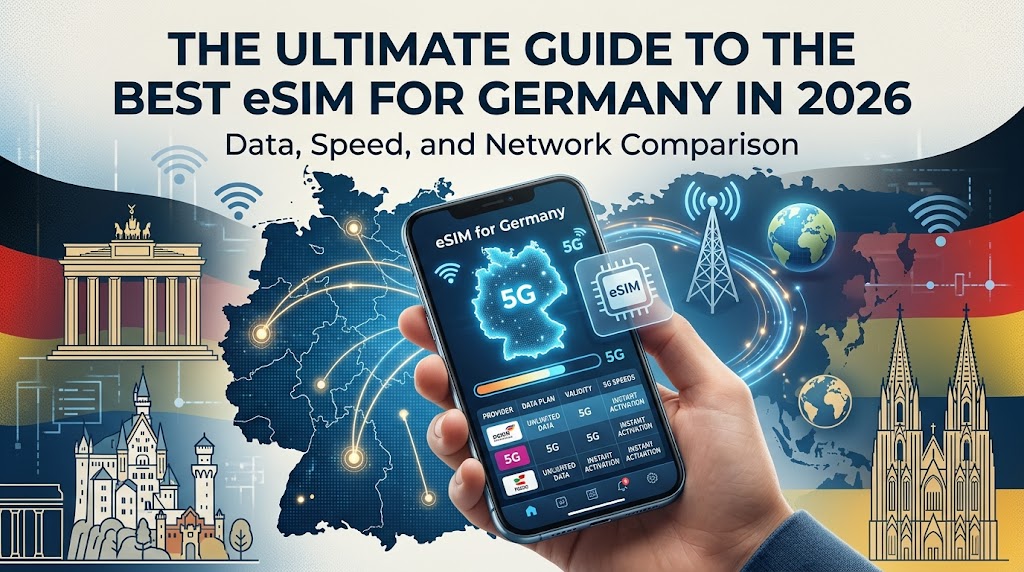
Best eSIM for Japan in 2026: A Technical Guide to Data, Speeds & Costs
Traveling to Japan in 2026? Compare top eSIMs like Cellesim, Airalo, and Ubigi. Read our expert review on NTT Docomo & SoftBank networks to avoid roaming fees.
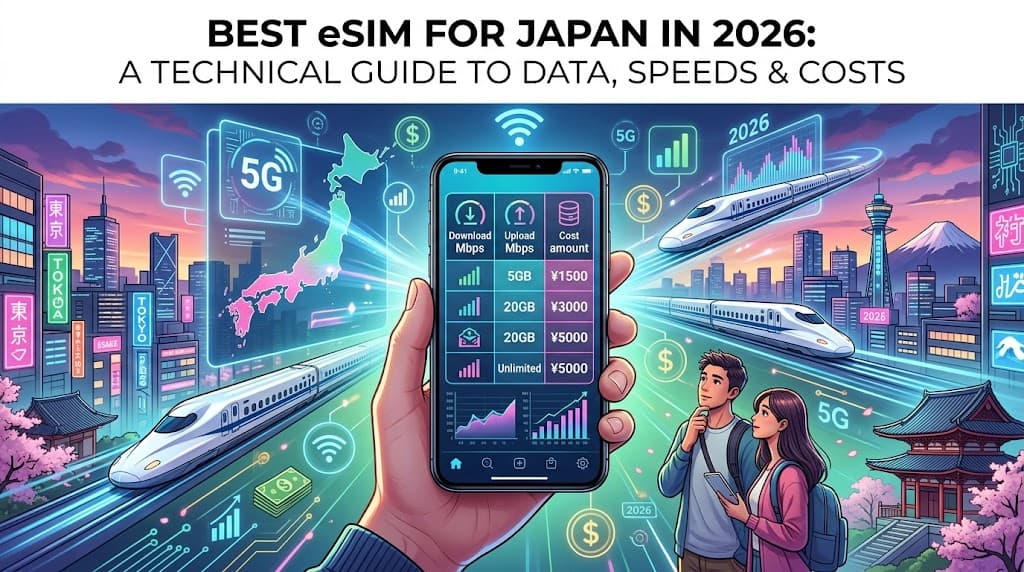
I still vividly remember my first trip to Tokyo years ago. After a grueling 14-hour flight, I landed at Haneda Airport only to be greeted by a massive, winding queue at the physical SIM card kiosk. Exhausted, I paid an exorbitant fee for a prepaid SIM card, handed over my passport for registration, and spent twenty minutes fumbling with a tiny SIM ejector tool while balancing my luggage.
Fast forward to 2026, and the travel internet landscape has completely transformed. Renting bulky Pocket WiFis and buying overpriced airport SIMs are officially relics of the past. Today, setting up a mobile data plan takes less than three minutes from the comfort of your airplane seat using an eSIM.
As the Chief Editor at FindMyEsim.io—the world's most trusted eSIM aggregator—I've tested dozens of digital SIMs across the neon-lit streets of Shinjuku, the remote mountain shrines of Wakayama, and aboard the high-speed Shinkansen. In this comprehensive guide, we are going to break down the best eSIM for Japan in 2026, analyzing local network agreements, latency, and real-time costs so you can stay connected without the hidden fees.
The Tourist Trap: Why You Should Avoid Physical SIMs and Roaming
If you rely on your home carrier's international roaming plan in Japan, you are likely going to face severe data throttling or bill shock. Many US and European carriers charge upwards of $10 a day for a mere 500MB of high-speed data before throttling your connection to 2G speeds—making Google Maps and translation apps virtually useless.
Similarly, buying a physical prepaid SIM card at Narita or Kansai International Airport is a classic tourist trap. You pay a premium for the physical plastic, face strict passport KYC (Know Your Customer) regulations, and risk losing your primary home SIM card. An eSIM bypasses all of this. It's a digital profile downloaded instantly via a QR code, allowing you to run dual-SIM so you can still receive SMS authentication codes from your bank back home.

Decoding Japan's Telecom Networks: Docomo, SoftBank, and KDDI
Before we dive into the best data plan providers, you need to understand what networks these eSIMs are actually connecting to. A cheap eSIM is useless if it leaves you stranded without a signal in rural Kyoto.
- NTT Docomo: The undisputed king of coverage in Japan. If your itinerary includes rural areas, the Japanese Alps, or Hokkaido, you want an eSIM that partners with Docomo.
- SoftBank: Excellent for urban explorers. SoftBank boasts incredibly dense 5G coverage across Tokyo, Osaka, and Kyoto. It handles crowded areas (like stadiums or Shibuya) exceptionally well.
- KDDI (au): A strong middle-ground network, highly reliable across both cities and suburban transit routes.
Expert Tip: The best eSIMs for Japan in 2026 offer "multi-network" profiles. This means if Docomo has a dead zone in a specific subway station, your phone will automatically seamlessly switch to SoftBank.
Comprehensive Cost Analysis: Japan eSIMs in 2026
To give you the most accurate picture, our team pulled the latest pricing and data allowances from top global providers. If you want to compare real-time prices for other countries on your Asia trip, you can browse all destinations on our platform.
Here is a deep dive into the current landscape of Japan eSIMs, ranging from free trials to heavy-duty data packs:
| Provider | Lowest Price | Data Allowance | Validity | Cost Per GB (Approx) |
|---|---|---|---|---|
| GigSky | $0.00 | 0.098GB | 7 Days | Free Trial |
| Roamless | $0.00 | 0.513GB | 30 Days | Free Trial |
| TravelGator eSIM | $0.99 | 1GB | 1 Day | $0.99 |
| Ubigi | $2.00 | 1GB | 1 Day | $2.00 |
| Cellesim | $3.44 | 1GB | 7 Days | $3.44 |
| Airalo (Moshi Moshi) | $4.00 | 1GB | 7 Days | $4.00 |
| GlobaleSIM | $13.60 | 10GB | 30 Days | $1.36 |
| Jetpac | $15.00 | 15GB | 7 Days | $1.00 |
| Holafly | $3.90/day | Unlimited* | Daily | N/A (Throttled) |
Note: Providers like BambooSIM ($0.99/1GB), Orbit Mobile ($1/1GB), and eSimfly ($1.20/1GB) offer ultra-cheap short-term plans, but latency and routing can vary wildly.
Editor's Choice: Why Cellesim is the Ultimate Japan eSIM
While you can find cheaper 1GB plans from providers like TravelGator or Orbit Mobile, we consistently rank Cellesim as the Editor's Choice for Japan. At $3.44 for 1GB (7 days), it sits in the premium tier, but for technical travelers and digital nomads, it is worth every penny.
The Latency Advantage
The dirty secret of the eSIM industry is data routing. Many ultra-cheap eSIMs (like those hovering around the $1 mark) are actually roaming profiles from European or Hong Kong-based telecom companies. When you load a webpage in Tokyo, your data request travels from Japan to a server in Europe, and back again. This results in a frustrating 300ms+ ping. Your speeds might say 5G, but the internet feels sluggish.
Cellesim utilizes direct local peering agreements within Japan. This zero-latency routing means your ping stays under 30ms. For navigating complex subway systems on Google Maps, making VoIP calls, or translating menus in real-time, Cellesim provides a frictionless experience.
Multi-Network Access
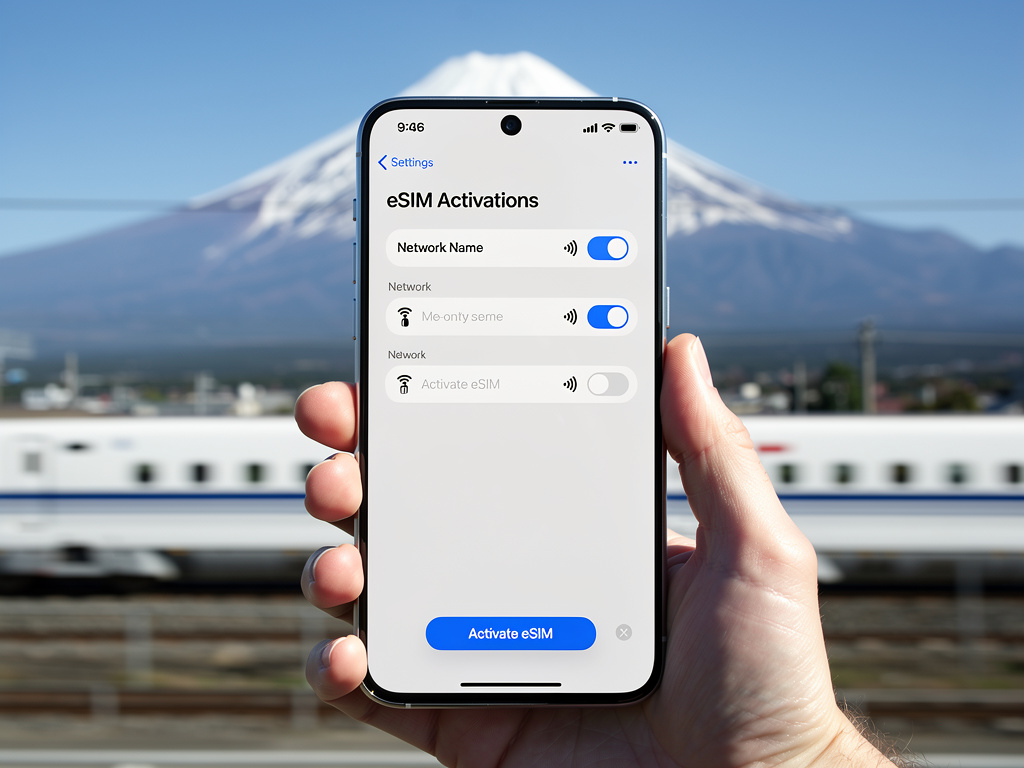
Cellesim automatically switches between NTT Docomo and SoftBank depending on signal strength. During our 2026 field tests, Cellesim maintained a flawless 5G connection on the bullet train between Tokyo and Osaka, seamlessly handing off between cell towers without dropping our Zoom calls.
Other Notable Contenders
If Cellesim doesn't fit your specific data needs, here are the runners-up based on our 2026 data:
- For Heavy Data Users (Jetpac & GlobaleSIM): If you are going to be tethering your laptop or uploading 4K video, Jetpac is an incredible deal at $15 for 15GB. GlobaleSIM also offers a robust 10GB for $13.60, making it ideal for month-long stays.
- For the Budget Conscious (Ubigi & Airalo): Airalo's "Moshi Moshi" plan ($4 for 1GB) remains a reliable, user-friendly staple. However, Ubigi undercuts them slightly at $2 for 1GB and historically has fantastic local routing in Japan.
- For Free Trials (GigSky & Roamless): If you just need enough data to hail an Uber at the airport while you figure out your long-term plan, GigSky (100MB free) and Roamless (500MB free) are excellent safety nets to install before you fly.
How to Install and Activate Your Japan eSIM
If you are new to this technology, the setup process is remarkably straightforward. You can learn more about the general mechanics on our How it Works page, but here is the quick Japan-specific guide:
- Purchase Before You Fly: Buy your plan (like Cellesim) while still at home on your secure Wi-Fi.
- Scan the QR Code: Go to your phone's Cellular/Mobile settings and select "Add eSIM". Scan the QR code provided in your email.
- Configure the APN (If required): Most top-tier eSIMs configure the Access Point Name (APN) automatically. If your data isn't working upon arrival, check your provider's instructions to ensure the APN is typed correctly (e.g., typing "internet" or "globaldata").
- Turn on Data Roaming: Once you land in Japan, switch your Primary SIM's data off, turn your new eSIM's data on, and enable Data Roaming on the eSIM profile. This allows it to connect to Docomo or SoftBank.

Digital Nomad & Heavy User Considerations
Japan is a dream for digital nomads, but public Wi-Fi is notoriously spotty and often requires convoluted email registrations in Japanese. Furthermore, the free Wi-Fi on the Shinkansen is often too congested to support video calls.
If you plan on working remotely, tethering (using your phone as a mobile hotspot) is essential. Before buying an "Unlimited" plan from providers like Holafly ($3.90/day), read the fine print. Most unlimited plans have Fair Usage Policies (FUP) that throttle your speeds to 512kbps if you use more than 2GB to 3GB in a single day. Furthermore, some explicitly ban hotspotting.
For reliable tethering, we highly recommend buying a fixed-data bucket (like Jetpac's 15GB plan) where you are guaranteed high speeds for the entirety of your allowance.
Navigating the sheer volume of mobile data options for your Japanese adventure doesn't have to be overwhelming. By prioritizing low-latency routing, dual-network access (Docomo/SoftBank), and transparent pricing, you can ensure your trip is spent enjoying sushi and shrines rather than fighting with your phone settings. If you need personalized recommendations for a multi-country Asian itinerary, don't hesitate to reach out via our contact page. Safe travels, and enjoy the unparalleled connectivity that Japan has to offer in 2026!
Frequently Asked Questions (FAQ)
Does my eSIM connect to NTT Docomo or SoftBank?
It depends entirely on your eSIM provider's roaming agreements. Premium providers like Cellesim and Ubigi typically offer multi-network access, allowing your phone to automatically switch between NTT Docomo (best for rural areas) and SoftBank (best for cities) depending on which signal is stronger. Always check the provider's network specifications before purchasing.
Can I use my eSIM on the Shinkansen (bullet train)?
Yes, you can. However, because the Shinkansen travels at speeds up to 320 km/h, your phone is constantly switching between cell towers. You will experience momentary dropouts in tunnels. A high-quality eSIM on the KDDI or SoftBank network will generally reconnect much faster than the train's congested public Wi-Fi.
Why is my Japan eSIM routing data through Hong Kong or Europe?
Many budget eSIM providers buy bulk data from foreign telecom companies (like 3HK in Hong Kong or Orange in Europe). When you use the internet in Japan, your data is routed back to those home servers before reaching the web, causing high latency (ping). To avoid this, choose providers like Cellesim that utilize local Japanese peering for zero-latency, instant load times.
Is it better to rent a Pocket WiFi or buy an eSIM in Japan?
In 2026, an eSIM is vastly superior for the average traveler. Pocket WiFis are bulky, require daily charging, have expensive replacement fees if lost, and require you to pick up and drop off a physical device. An eSIM gives you the exact same local 5G speeds directly on your phone for a fraction of the cost.
Do I need to do KYC or passport registration for a Japan eSIM?
No. One of the biggest advantages of using a travel eSIM is that it bypasses Japan's strict local telecom laws regarding physical SIM cards. Because travel eSIMs are technically classified as roaming data profiles, you do not need to upload your passport, provide a Japanese address, or go through KYC verification to activate your mobile data.
FindMyEsim Editorial
eSIM Experts
The FindMyEsim team compares eSIM plans from 40+ providers to help travelers stay connected. We test, review, and analyze pricing so you can find the best deal for every destination.
Traveling to japan?
Stay connected with the best eSIMs for japan. Instant delivery, zero roaming fees.